
Power Grid Polemic: Centralized Power Grids vs. Decentralized Microgrids
Updated: Sep 13
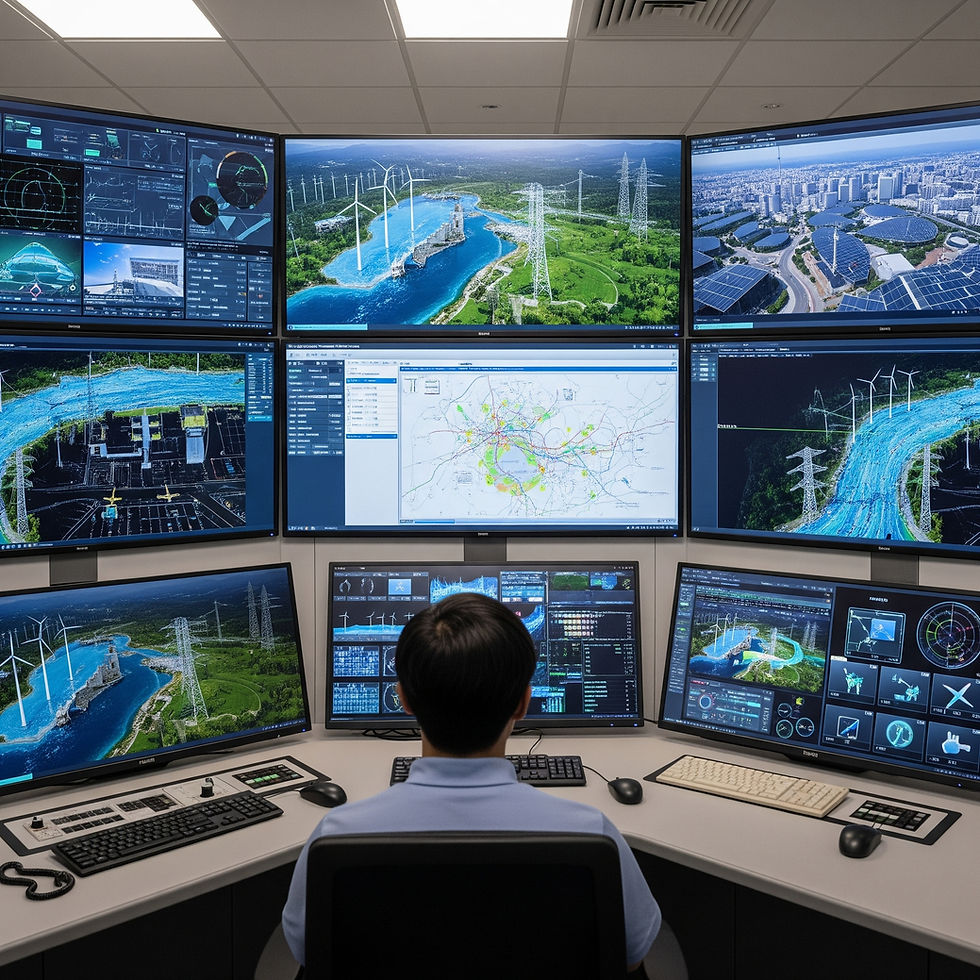
👑🔋 The Future of Energy Resilience
For over a century, our modern world has been exclusively powered by the Centralized Power Grid: a massive, top-down, monopolistic marvel of industrial engineering. In this legacy system, massive power plants (coal, nuclear, natural gas) burn fuel to push electricity blindly outwards across vast, fragile networks of transmission lines to millions of passive consumers.
This model built the 20th century. But as humanity faces the brutal, existential challenges of a new era—extreme climate-driven weather, sophisticated state-sponsored cybersecurity threats, and the absolute necessity of transitioning to renewable energy—a highly agile, data-driven contender has emerged: the Decentralized Microgrid.
A microgrid is a small-scale, localized energy network that can operate completely independently. It generates, stores, and distributes its own power within a strictly defined community footprint, such as a university campus, a sprawling hospital complex, or a residential neighborhood.
This is a polemic with profound geopolitical and economic consequences. It is a battle between the established, monolithic, highly vulnerable stability of the traditional grid and the nimble, self-sufficient, algorithmic resilience of a localized network. As we engineer the survival systems of tomorrow, where should the actual physical power truly lie?
Welcome to the aiwa-ai.com portal! We've aggregated the most rigorous, peer-reviewed global energy grid data and macroeconomic analytics 🧭 to bring you a curated breakdown of the Power Grid Polemic. Let's plug into this critical energy debate. 🚀
🧠 Brief Summary: The Script for Energetic Sovereignty
The operational architecture of global energy is undergoing a profound, data-driven evolution. The power grid—historically defined by massive central monopolies and passive consumption—is transitioning into a hyper-efficient, predictive science of localized solar generation, battery storage, and AI load balancing. The neighborhood in 2026 acts as its own autonomous power plant. From the undeniable reality that centralized grids suffer catastrophic cascading failures during hurricanes, to the proof that microgrids allow hospitals to survive off-grid indefinitely, this analysis provides a visionary roadmap. As these dynamics transition energy from a utility bill into a democratized asset, the "Script That Will Save People" ensures this knowledge democratizes energy access for marginalized communities, systematically eliminates lethal blackouts during extreme weather, and fiercely protects the electrical grid from cyber-warfare.
💡 AIWA-AI Perspective: Engineering the Resilient Electron
"Electricity is the absolute foundational algorithm of modern human survival; when the grid fails during a freezing winter storm because a single transmission line snapped 500 miles away, the systemic harm manifests as frozen pipes, collapsed hospital life-support systems, and preventable mass casualties. Historically, securing power meant paying a monopoly utility to burn coal and hoping the wires didn't snap. This is exactly where the 'Script That Will Save People' rewrites the architecture of survival. Under 'The Humanity Scenario: Protecting Our Essence,' technology absolutely must not be deployed to build a brittle, centralized infrastructure vulnerable to a single cyber-attack, nor to legally prevent citizens from generating and sharing their own solar power. Instead, the hard numerical truth must be aggressively utilized as the ultimate, democratizing engine for radical energy independence, absolute extreme-weather resilience, and equitable green power distribution. It is a script that uses data to empirically prove that an AI-managed community microgrid keeping a neighborhood's heating on during a Category 5 hurricane is infinitely more valuable than a fragile centralized monopoly. The visionary electrical engineers, grid-tech coders, and civic leaders actively verifying these trends are not just wiring houses; they are actively architecting a profoundly fairer, deeply resilient, and radically sustainable global civilization where the power to survive literally belongs to the people."
Quick Navigation: An Energy Inquisition
I. 🛡️ Reliability & Resilience: Who Keeps the Lights On During a Storm?
II. ☀️ Renewable Energy Integration: Who is Friendlier to Solar and Wind?
III. 💰 Cost & Economics: Who Delivers Cheaper, More Stable Power?
IV. 🤝 Equity & Democratization: Who Gives Power to the People?
V. 🏆 The Royal Decree & The "Energy Covenant" Protocol
Here is your comprehensive, philosophical analysis, categorized by the core questions that strictly define a secure and sustainable energy future.
I. 🛡️ Reliability & Resilience: Who Keeps the Lights On During a Storm?
As climate change exponentially increases the frequency and brutality of extreme weather events (hurricanes, deep freezes, wildfires), the physical ability to withstand and instantly recover from disruption is paramount to human survival.
🥊 The Contenders: A sprawling, highly interconnected macro-grid vulnerable to devastating single points of failure vs. a self-sufficient, closed-loop "island" of local power.
🏆 The Verdict: Decentralized Microgrids, decisively.
📜 The Philosophical Decree:
The centralized grid is a fragile, mathematically terrifying giant. A single downed high-voltage transmission line from a hurricane, or a targeted cyber-attack on a regional substation, can cause a cascading, domino-effect blackout affecting tens of millions of people instantly.
A microgrid, by direct structural contrast, possesses the algorithmic ability to instantly sever its connection from the collapsing main grid (known as "islanding"). Once islanded, it continues to power its local community autonomously using its own internal resources (like localized solar panels, wind turbines, and massive lithium-ion battery banks). This fundamental ability to sever ties with a failing macro-system makes it structurally immune to cascading failures, ensuring that critical, life-saving infrastructure—like hospitals, water treatment plants, and emergency shelters—remain fully online when they are needed most.
II. ☀️ Renewable Energy Integration: Who is Friendlier to Solar and Wind?
The absolute necessity of transitioning to a green, zero-carbon economy depends entirely on our engineering ability to successfully integrate highly variable, unpredictable renewable sources like solar and wind. This is a battle of mathematical flexibility.
🥊 The Contenders: A rigid, one-way grid designed exclusively for a few massive, continuous power plants vs. a highly dynamic, two-way neural network designed for thousands of small, fluctuating producers.
🏆 The Verdict: Decentralized Microgrids.
📜 The Philosophical Decree:
Legacy centralized grids were built specifically for the predictable, constant, unyielding "baseload" output of coal and natural gas plants. They mathematically struggle to manage the variable, intermittent nature of renewables. When the sun shines too brightly in one specific region, the sudden surge of solar power can actually physically overload and damage local transformers.
Microgrids are explicitly engineered for this chaotic reality. They utilize highly advanced, AI-driven smart technology and local battery storage to effortlessly, algorithmically balance local supply and demand in real-time. They soak up and store excess solar power during peak daylight, and discharge it seamlessly at night, completely masking the volatility of renewables from the fragile larger system. They are the mandatory, foundational partners for a world powered by distributed green energy.
III. 💰 Cost & Economics: Who Delivers Cheaper, More Stable Power?
This is an incredibly complex financial battle weighing massive upfront infrastructure costs, daily transmission losses, and volatile energy market dynamics.
🥊 The Contenders: The massive "economies of scale" of the centralized grid vs. the vastly reduced transmission costs and active market participation of decentralized microgrids.
🏆 The Verdict: A draw, with the definitive future economic leaning heavily towards Decentralized Microgrids.
📜 The Philosophical Decree:
The centralized grid historically benefits from massive economies of scale in raw power generation. However, a huge, hidden portion of a consumer's electricity bill pays strictly for the maintenance of thousands of kilometers of fragile transmission lines. Furthermore, a significant amount of actual electrical energy (often 5% to 8%) is physically lost as heat just traveling along those massive wires (line loss).
Microgrids generate power exactly where it is physically consumed, mathematically eliminating these transmission losses and infrastructure costs entirely. Furthermore, modern regulations are finally allowing microgrids to sell their excess stored battery power back to the main grid during peak demand events (like heatwaves), creating massive new revenue streams and heavily lowering baseline costs for their community members. While the upfront CapEx setup cost of a microgrid is high, its long-term, zero-fuel economic efficiency is a devastating advantage.
IV. 🤝 Equity & Democratization: Who Gives Power to the People?
This is the ultimate philosophical battle over societal control. Is electrical energy merely a physical commodity delivered by a monopolistic utility corporation, or is it a fundamental survival resource generated, owned, and shared by a community?
🥊 The Contenders: A top-down, authoritarian system controlled by a few massive, for-profit utility monopolies vs. a bottom-up, democratized system owned and controlled by local communities.
🏆 The Verdict: Decentralized Microgrids, unequivocally.
📜 The Philosophical Decree:
The traditional centralized model purposely creates captive, passive consumers who have zero control over sudden price hikes or blackout schedules.
The decentralized microgrid model radically creates active "prosumers"—households and local businesses that simultaneously produce and consume energy. This structurally democratizes the entire energy system, allowing local communities to completely control their own power supply, set their own internal prices, and build generational local wealth rather than exporting capital to a distant utility board. It fosters a profound culture of true energy independence and empowers ordinary citizens to become highly active, profitable participants in the green energy transition.
🌍 V. The Royal Decree & The "Energy Covenant" Protocol
The hostile polemic between a centralized grid and decentralized microgrids is ultimately a false, binary choice. The inherent weakness of one is the exact mathematical strength of the other. To build a truly resilient, survivable, and highly efficient energy system for the 21st century, we absolutely need both.
The crown is officially not awarded to a single model, but to an intelligent, highly integrated algorithmic architecture: An Interconnected System of Systems.
In this definitive future, a modernized, robust centralized grid acts exclusively as the high-voltage "superhighway," efficiently moving massive amounts of power over long distances (e.g., transporting power from offshore wind farms to inland industrial centers).
This highway connects dozens, hundreds, and eventually millions of highly resilient, localized decentralized microgrids. These microgrids algorithmically manage their own local neighborhood needs first, but can instantly buy, sell, and route power with their neighbors through the main grid, creating an ecosystem that is both impervious to collapse at the local level and massively powerful at the national level.
This vision requires a strict, new social contract for how we legally produce and consume energy.

🌱 The "Energy Covenant": A Script for a New Power Future
In line with our mission at aiwa-ai.com, we propose this empirical framework for building an energy infrastructure that guarantees human survival and equity.
🛡️ The Mandate of Resilience First: Governments must legally prioritize and heavily subsidize the immediate development of independent microgrids for all critical infrastructure: hospitals, emergency fire services, water treatment plants, and community storm shelters. The systems that keep humans alive must mathematically be able to function entirely independently of the main grid's failure.
💖 The Command of Local Empowerment: Enact aggressive legislation that makes it legally effortless and financially viable for communities, poor neighborhoods, and individuals to install renewable energy and form their own localized microgrids. Legally destroy the monopolistic utility barriers to entry for participation in the energy market.
🧠 The "No-Wrong-Door" Principle for Electrons: Invest billions in AI-driven smart grid technology that allows for seamless, real-time, two-way algorithmic communication between the central grid and local microgrids. The macro-system must be intelligent enough to automatically draw on stored battery power from a neighborhood microgrid during a brutal peak demand heatwave, preventing a regional blackout.
⚖️ The Equity Edict: Ensure that the massive financial benefits of the clean energy transition are explicitly shared by the marginalized, not just the wealthy who can afford solar panels. Governments must use public funding to build community-owned solar microgrids in low-income and historically disadvantaged neighborhoods, drastically lowering their crushing energy bills and creating local green jobs. The green economy must absolutely be a just economy.
🤝 The Efficiency Imperative: The absolute cleanest, cheapest unit of energy is the one you mathematically never have to produce. Alongside building a resilient new grid, we must aggressively, legally enforce strict energy efficiency standards in our homes, commercial buildings, and heavy industries. Slashing baseline energy demand is the single most powerful and cost-effective energy strategy on Earth.
By adopting this covenant, we can build a planetary energy system that is not only 100% clean and highly resilient to disaster, but also profoundly more democratic and economically just.
💬 Your Turn: Join the Discussion!
The fundamental structure of the energy grid dictates the absolute survival capability of your family during a crisis. We want to hear your unvarnished perspective.
Have you ever personally experienced a prolonged, multi-day power blackout (like the Texas freeze)? How did it physically impact your family and your immediate community?
Would you be highly interested in financially joining a "community solar" project or a local neighborhood microgrid if the utility monopoly allowed it in your area?
What do you see as the absolute biggest political or corporate obstacle preventing a much faster transition to decentralized renewable energy in your specific country?
How can society financially encourage more low-income families to invest in vital energy efficiency (like better insulation) in their own homes?
Do you philosophically believe that individual humans have a fundamental legal right to generate their own power and completely disconnect from the corporate main grid?
Share your thoughts, experiences, and energy ideas in the comments below! 👇
📖 Glossary of Key Terms:
Centralized Power Grid: The highly fragile, traditional legacy energy network where electricity is generated at a few massive, central power plants and pushed blindly over incredibly long distances to completely passive consumers.
Decentralized Microgrid: A highly localized, technologically self-sufficient energy grid possessing its own power generation resources (like solar panels) and localized energy storage (like massive battery banks). It can instantly connect to or disconnect from the main grid.
Resilience (Grid): The mathematical and structural ability of a system to withstand, absorb, and instantly recover from catastrophic disruptions, such as Category 5 hurricanes or targeted nation-state cyberattacks.
Island Mode: The vital, life-saving ability of a smart microgrid to detect a blackout, instantly sever its physical connection from the collapsing main grid, and operate entirely independently using its own local solar power and batteries.
Prosumer: A revolutionary economic term for an individual or entity that simultaneously produces and consumes a product. In energy, it refers to a household with solar panels that uses its own power and automatically sells the excess back to the market for profit.
📝 Terms & Conditions
ℹ️ For Informational Purposes Only: This post is for general informational and philosophical analysis, aligned with the educational mission of the AIWA-AI portal. It does not constitute professional electrical engineering, grid architecture, or financial investment advice.
🔍 Due Diligence Required: Energy systems, heavily lobbied utility regulations, and solar technologies are wildly complex and vary significantly by specific state, country, and municipal region. Always consult with qualified solar professionals and local regulatory authorities.
🚫 No Endorsement: This analysis does not constitute an official corporate endorsement of any specific energy technology, solar company, or political utility policy by aiwa-ai.com.
🧑⚖️ User Responsibility: The "Energy Covenant" Protocol is a guiding ethical framework. Individuals and communities are solely, legally responsible for their own energy infrastructure choices and must absolutely comply with all relevant federal safety standards and local building codes.

Posts on the topic 🔋 AI in Energy:
How Will AI Ensure a Fair Distribution of "Light"?
Power Grid Polemic: Centralized Power Grids vs. Decentralized Microgrids
Powering Up: 100 AI Tips & Tricks for the Energy Sector
Energy Sector: 100 AI-Powered Business and Startup Ideas
Energy: AI Innovators "TOP-100"
Energy: Records and Anti-records
Energy: The Best Resources from AI
Statistics in Energy from AI
The Best AI Tools in Energy
Sentient Energy Ecosystems: Co-Created Grid Intelligence. Energy Sustainability
Integration of Renewable Energy AI and The Emergence of Self-Adaptive Sustainable Ecosystems
AI and Energy Harmony: Shared Energy Consciousness
Forecasting Intelligent AI assets. Co-Creating Sustainable Ecosystems
The Energy Markets: AI's Sentient Trading Orchestration, Co-Created Market Sentience
AI's Exploration, Production, and Sustainable Stewardship in the Oil & Gas Sector
Explore key AI Trend Battles and clashes shaping our future
Hiring Hotspots Heat-Up: Remote-First Company Culture vs. A Return to the Office
Accommodation Antagonism: Boutique Hotels vs. Airbnb Experiences
Community Dynamics Duel: Online Social Movements vs. Grassroots Activism
Translation Tech Tangle: AI-Powered Machine Translation vs. Human Expertise
Console Wars: PlayStation 5 vs. Xbox Series X vs. Nintendo Switch
Artistic Avenues Square Up: Digital Art (NFTs) vs. Traditional Canvas
The Building Battleground: Prefabricated & Modular Construction vs. Traditional On-site Building
Retail Revolution Rumble: Fast Fashion's Dominance vs. The Rise of Thrifting
Short-Form Video vs. Long-Form Content: The Battle for Audience Attention
The "15-Minute City" Concept vs. Suburban Sprawl: Redefining Modern Urban Living
The Forecast Face-Off:AI-Powered Predictive Models vs. Traditional Synoptic Forecasting
Sustainability Strategies Struggle: Carbon Offsetting vs. Direct Emission Reduction
Connecting the World: 5G Networks vs. Satellite Internet
Space Race Revival: National Space Agencies vs. Private Space Exploration
Scientific Research: The Research Revolution Rumble
Civic Tech Conflict: E-Governance Portals vs. In-Person Services
Legal Tech Tussle: AI-Powered Legal Research vs. Traditional Paralegal Work
Power Grid Polemic: Centralized Power Grids vs. Decentralized Microgrids
Cybersecurity Clash: Proactive Threat Hunting vs. Reactive Incident Response
Streaming Giants Clash: Netflix's Binge Model vs. Disney+'s Weekly Drops
Farming Futures Feud: Precision Agriculture vs. Traditional Farming Methods
Retail Royal Rumble: Social Commerce vs. Traditional E-commerce Websites
Production Power Play: 3D Printing vs. Traditional Manufacturing
Automotive Arena: Electric Vehicles (EVs) vs. Hydrogen Fuel Cell Cars (FCVs)
Investment Ideologies Implode: Robo-Advisors vs. Traditional Financial Planners
Patient Care Paradigm Clash: Telemedicine Consultations vs. In-Person Doctor Visits
Learning Platforms Face-Off: Online Courses vs. Traditional Degrees
Smart Home Showdown: Google Assistant vs. Amazon Alexa


Comments