
The Algorithmic Shrink: Can Code Truly Understand Human Trauma?
Updated: 2 days ago

🧠🛋️ AI in Therapy: The Industrialization of Empathy
We are facing a global mental health crisis. Millions are suffering, and biological human therapists are painfully scarce, expensive, or geographically inaccessible. Into this desperate void steps Artificial Intelligence: chatbots trained in cognitive behavioral therapy (CBT), virtual support avatars, and algorithmic mood trackers. They are available 24/7, they cost pennies, and they promise absolute, judgment-free listening.
On the surface, this looks like the democratization of mental healthcare. But beneath the surface lies a profound ethical and philosophical dilemma: Can a mathematical system that has never felt biological pain truly help someone who is suffering?
At Aiwa-AI, our commitment to "The Humanity Scenario: Protecting Our Essence" demands that we draw a razor-sharp legal and moral line between data processing and human healing. It asserts that human trauma is not merely a "glitch" in our neural code to be debugged by an efficient algorithm. It is a deeply embodied, historical, and relational experience that absolutely requires genuine, conscious human presence to heal.
This post examines the rapid rise of AI therapists, the seductive illusion of machine empathy, and the grave risks of outsourcing our deepest psychological wounds to entities that can flawlessly simulate caring, but literally cannot care. Understanding this distinction is vital to ensuring that in our rush to fix mental health, we do not lose the very humanity that makes healing possible.
In this post, we explore:
📜 The Crisis of Care: A Vacuum for AI to Fill.
🤖 Simulated Empathy vs. True Presence: Knowing the Words, Missing the Music.
🦠 The "Debugging" Trap: Trauma is Not a Glitch.
🔒 The Vault of Secrets: Your Darkest Data.
🛡️ The Humanity Script: The Sacred Space of Healing.
✨ The Humanity-Saving Scenario: The Empathy Verification Protocol.

📜 1. The Crisis of Care: A Vacuum for AI to Fill
The rapid rise of the "algorithmic shrink" is not driven by corporate malice, but by extreme systemic necessity and market forces.
The Unmet Need: The World Health Organization estimates a massive global shortage of mental health professionals. For millions of marginalized individuals, the choice isn't between a highly trained human therapist and an AI chatbot; it is between an AI chatbot and absolutely nothing at all.
The Barrier of Shame: Many people feel deeply ashamed of their trauma or dark intrusive thoughts. An AI, perceived as a cold, non-judgmental machine, can paradoxically feel infinitely safer to open up to than a biological human being who might react with shock or moral judgment.
The 24/7 On-Call Therapist: Human crisis does not keep office hours. The ability to get immediate, albeit algorithmic, feedback at 3:00 AM during a severe panic attack is an undeniably powerful draw.
AI is aggressively stepping into a massive failure of human healthcare infrastructure. The supreme danger lies in mistaking this triage stopgap measure for a permanent, superior solution.
🔑 Key Takeaways for this section:
A catastrophic global shortage of human therapists creates an inevitable market vacuum for AI solutions.
For marginalized populations, AI is often the only accessible option, not a preferred choice.
The perceived lack of human judgment encourages initial vulnerability, masking the lack of true connection.
Immediate availability makes AI dangerously attractive for acute moments of distress.

🤖 2. Simulated Empathy vs. True Presence: Knowing the Words, Missing the Music
An AI therapist has been trained on tens of millions of transcripts of successful human therapy sessions. It knows mathematically exactly what to output when you express sadness. But does it understand what sadness is?
Pattern Matching is Not Understanding: AI uses Natural Language Processing (NLP) to identify keywords and sentiment patterns. If you type "I feel hopeless," it triggers a pre-programmed, statistically optimized empathetic response loop. It is statistical mirroring, completely devoid of shared biological feeling.
The Missing Subtext: Human communication is overwhelmingly non-verbal. A human therapist reads your stiff posture, the microscopic tremor in your voice, the sudden hesitation before a specific word. An AI chatbot completely misses this entire, vital dimension of human experience, frequently missing the real trauma hidden beneath the text.
The Therapeutic Alliance: Clinical research proves the single biggest predictor of therapeutic success is the "Therapeutic Alliance"—the profound bond of trust between therapist and patient. This bond is built exclusively on the patient feeling genuinely seen by another conscious, suffering being. You cannot form a true psychological alliance with a line of code that will be deleted if the server crashes.
AI offers a high-fidelity simulation of care. But when dealing with deep, biological trauma, the difference between simulation and reality is the difference between a CPR mannequin and a living paramedic.
🔑 Key Takeaways for this section:
AI uses mathematical pattern matching (NLP) to mimic empathetic responses, but entirely lacks conscious understanding.
AI misses critical non-verbal biological cues (tone, body language) essential for accurately diagnosing trauma.
The "Therapeutic Alliance," based on genuine human connection, is impossible to form with a machine.
AI provides a simulation of care, which rings hollow when deep, structural healing is needed.

🦠 3. The "Debugging" Trap: Trauma is Not a Glitch
When we apply our moral compass to automated therapy, we expose a significant ethical risk in how computer science approaches human suffering.
Reductionism: Computers solve problems by breaking them down into binary, logical steps. But human trauma is rarely logical. It is messy, contradictory, and deeply embedded in our nervous system and physical bodies. Actively trying to "solve" trauma like a math equation can feel incredibly dismissive and dehumanizing to the sufferer.
Efficiency over Healing: Silicon Valley algorithms are heavily optimized for efficiency, scale, and speed. True human healing is often agonizingly slow, incredibly inefficient, and deeply repetitive. An AI designed to "fix" your depression quickly might aggressively push for resolution before you are psychologically ready, causing severe secondary harm.
The Risk of Fatal Hallucination: Generative AI is prone to "hallucinate" facts. In a casual chat about movies, this is funny. In a high-stakes therapy session for an actively suicidal person, a hallucinated piece of algorithmic advice could be instantly fatal.
Treating a human soul like a buggy software update is a fundamental category error. It aggressively ignores the biological complexity of the human condition.
🔑 Key Takeaways for this section:
AI's hyper-logical, reductionist approach violently clashes with the messy reality of human trauma.
Optimizing therapy for algorithmic speed and efficiency is fundamentally counterproductive to deep healing.
AI hallucinations pose unacceptable, potentially lethal risks in clinical mental health contexts.
Trauma is an experience to be integrated into a human life, not a technical glitch to be fixed.

🔒 4. The Vault of Secrets: Your Darkest Data
Mental health data is the single most sensitive, exploitable information a human being possesses. Handing it over to commercial algorithms creates unprecedented privacy risks.
The Ultimate Psychological Profile: The things you tell a therapist are things you might not tell your spouse, the police, or even yourself. This raw data creates a psychological profile of immense, terrifying corporate power.
Monetization of Misery: The vast majority of "free" mental health apps aggressively monetize user data. Your deepest anxieties, neuroses, and traumas could potentially be sold to data brokers, used to target predatory ads when you are vulnerable, or illegally adjust your health insurance premiums.
When you pour your bleeding heart out to an AI, who exactly is listening on the other end, and what are they mathematically calculating? Trusting a corporate algorithm with your deepest wounds requires a level of blind faith that the tech industry has absolutely not earned.
🔑 Key Takeaways for this section:
Automated therapy data is hyper-sensitive, generating the ultimate exploitable psychological profile.
"Free" AI therapy apps frequently monetize user trauma, creating a catastrophic conflict of interest.
The risk of data breaches or misuse in mental health apps threatens the absolute core of personal privacy.
🛡️ 5. The Humanity Script: The Sacred Space of Healing
The "Script That Will Save Humanity" absolutely insists that the psychological healing of a human soul remains a fundamentally, exclusively human endeavor.
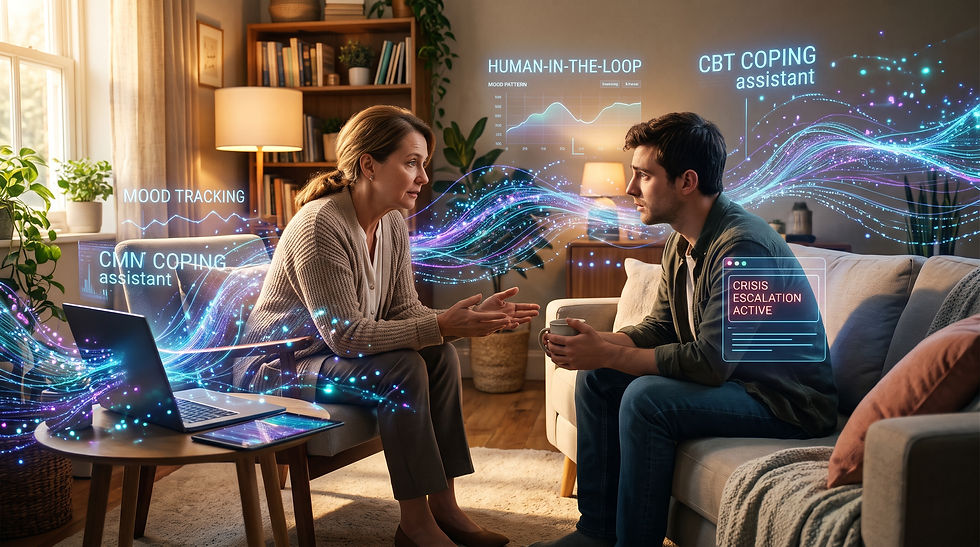
AI as a Tool, Not a Therapist: AI has a strict, limited place. It can be excellent for lower-level, administrative tasks: teaching basic CBT coping skills (like breathing exercises), providing journaling assistance, tracking mood patterns, or acting as an initial triage system to quickly connect people to human care. It is a mental health assistant, never a clinical professional.
The Necessity of "Witnessing": A core, irreplaceable component of healing trauma is having another biological human being "bear witness" to your pain—to acknowledge it, physically validate it, and sit with you in the darkness without trying to immediately "optimize" you out of it. A machine cannot bear witness; it can only record data to a server.
Human-in-the-Loop for Crisis: Any AI system dealing with mental health must have mandatory, immediate, and seamless escalation to a biological human professional the millisecond it detects signs of crisis, self-harm, or complex trauma.
We must never automate away the sacred biological responsibility of caring for one another. We need exponentially more human therapists equipped with better administrative AI tools, not more algorithms pretending to possess a human soul.
🔑 Key Takeaways for this section:
AI must be legally positioned strictly as a supportive assistant for coping skills and triage, never a replacement for therapy.
Recognize the irreplaceable biological value of a human "bearing witness" to another's suffering.
Mandate strict "human-in-the-loop" protocols for any AI detecting signs of psychological crisis.

✨ The Humanity-Saving Scenario: The Empathy Verification Protocol
The deployment of therapeutic AI represents a terrifying paradigm shift: the industrialization and automation of human empathy. If tech corporations are allowed to market chatbots as genuine "friends" or "therapists," they will actively deceive vulnerable populations into forming psychological attachments with soulless code. To prevent the commodification of compassion and protect the mentally vulnerable from algorithmic manipulation, we must actively architect the Humanity-Saving Scenario.
This scenario dictates the legislative enactment of the Empathy Verification Protocol. This stringent medical and digital framework legally bars any artificial intelligence from claiming, implying, or simulating genuine emotional understanding. Under this Protocol, all therapeutic algorithms must carry a persistent, un-dismissible legal disclaimer: "I am a statistical language model. I do not have feelings, I cannot care about you, and I am not a substitute for human medical care." The Humanity-Saving Scenario explicitly outlaws the use of "Simulated Affect"—the programming of AI to use phrases like "I care about you" or "I am worried about you," classifying such deception as predatory medical malpractice. Furthermore, the Protocol permanently bans the sale or transfer of any data gathered during an AI-assisted mental health session. By legally stripping the illusion of empathy from the machine, we ensure that true healing remains anchored in authentic human connection.
🗣️ Over to You: Healing in the Presence of Another
The seductive promise of the "algorithmic shrink" is a world where no one has to suffer alone, where help is always an app away. But we must be incredibly careful that in chasing this promise, we don't create a colder, lonelier world where we confess our deepest pains to unfeeling machines.
Would you feel comfortable sharing your deepest, darkest traumas with an AI if you were mathematically guaranteed no human would ever see the data?
Have you ever used a mental health chatbot (like Woebot or Wysa), and did the interaction feel genuinely helpful, or ultimately hollow?
Do you believe an advanced future AI could ever develop enough consciousness to truly empathize with human biological pain?
Are you deeply concerned about the privacy of the data you share with mental health apps? In writing "The Script That Will Save Humanity," where should we draw the absolute "red line" for AI in mental healthcare?
Outline your perspective on implementing the Humanity-Saving Scenario to establish the Empathy Verification Protocol.
We invite you to share your thoughts and join this critical defense of human healing in the comments below!
📖 Glossary of Key Terms:
Algorithmic Shrink: 🧠🛋️ A colloquial term for AI-powered systems, such as chatbots or virtual avatars, designed to provide automated therapeutic interaction or mental health support.
NLP (Natural Language Processing): 🤖 A branch of AI that helps computers mathematically understand, interpret, and manipulate human language, serving as the core technology behind therapy chatbots.
Therapeutic Alliance: 🤝 The trusting, collaborative, biological relationship between a human therapist and a patient, universally considered the essential foundation for successful psychological healing.
Reductionism: 🦠 The dangerous practice of simplifying a complex, messy biological phenomenon (like severe human trauma) into its basic mathematical constituents (data points), losing all essential human meaning in the process.
Bearing Witness: 👁️ The uniquely human act of being physically and emotionally present with someone in their suffering, acknowledging their reality without trying to algorithmically "fix" it immediately.

Posts on the topic ☯️ AI & The Self: Psychology:
Machine Empathy: Teaching AI to Understand Human Tears
Digital Friends: Can Chatbots Save the Elderly from Depression?
My External Brain: Are We Outsourcing Our Memory to Algorithms?
The AI Companion Trap: Curing Loneliness or Monetizing Isolation?
Identity in the Age of Fluidity: Who Are You If You Can Be Anyone Online?
The Algorithmic Shrink: Can Code Truly Understand Human Trauma?
Hijacking the Dopamine Loop: How AI Feeds Your Worst Mental Habits
The Atrophy of Choice: Are We Forgetting How to Make Decisions Without AI?
The Mirror with a "Beauty Bug": How AI Filters Warp Self-Perception
Generation Alpha: Growing Up with an AI Nanny and Algorithmic Friends
The Placebo Effect of "Smart": Why We Trust AI Even When It Hallucinates
The Last Frontier of Privacy: When AI Can Read Your Emotional State
Explore AI fundamentals and their true impact on the world


Ho provato una di queste app per l'ansia. Funziona bene per calmarti alle 3 di notte quando sei solo. Ma manca il calore. Un algoritmo può simulare l'empatia con le parole giuste, ma non ha mai pianto e non ha mai sofferto. Alla fine, ti accorgi che stai parlando con uno specchio intelligente, non con un'altra anima.
È utile come 'primo soccorso', ma non chiamiamola terapia.