
Weather Wisdom: 100 AI Tips & Tricks for Meteorology & Forecasting
Updated: Sep 25
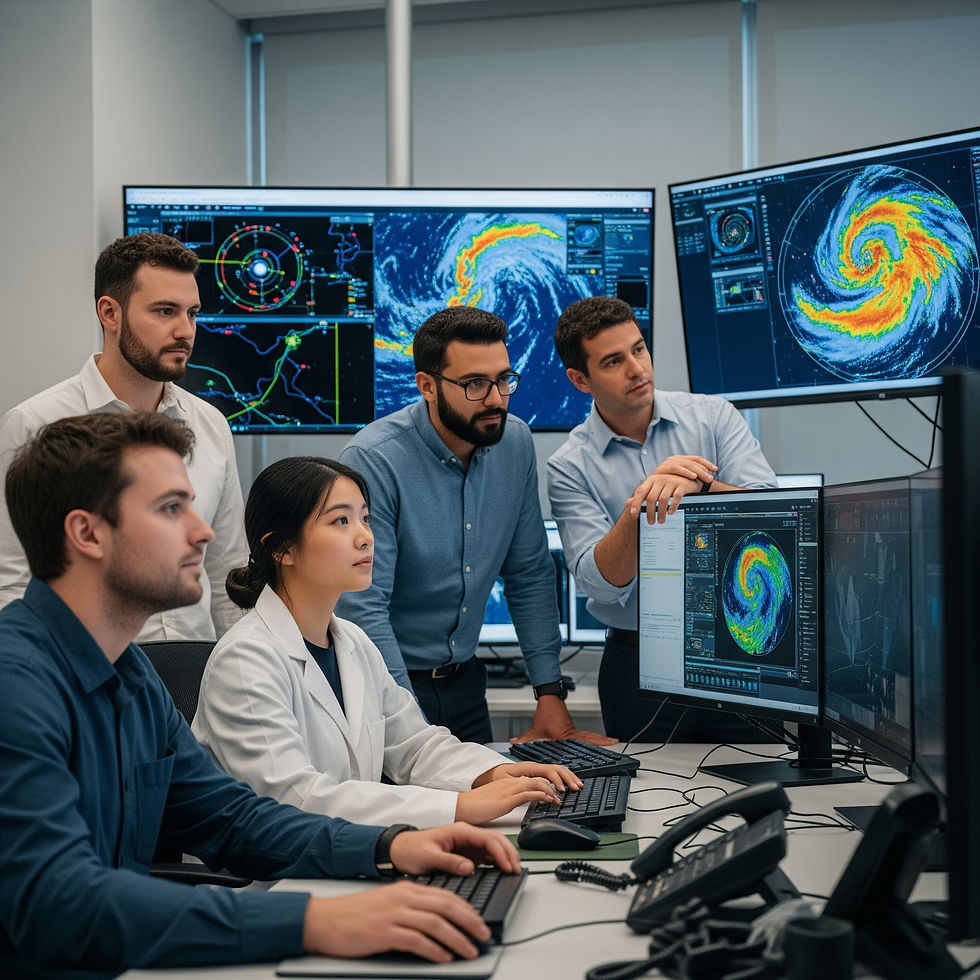
🔰🌦️ Unveiling Atmospheric Secrets and Enhancing Prediction with Intelligent Insights
The atmosphere is a dynamic, complex system, and accurately predicting its behavior has always been one of humanity's greatest scientific and technological challenges. From anticipating severe storms and optimizing agricultural planting schedules to managing renewable energy grids and ensuring public safety, precise weather information is critical for countless human activities. Yet, traditional forecasting methods grapple with vast data, chaotic dynamics, and localized variations. This is precisely where Artificial Intelligence offers a "Script That Will Save People" by transforming how we gather, process, and interpret atmospheric data, leading to forecasts that are faster, more accurate, more granular, and ultimately more impactful.
AI in meteorology isn't just enhancing traditional weather models; it's revolutionizing how we understand the very air we breathe. It's about providing unprecedented precision for hyper-local conditions, predicting climate shifts with greater confidence, optimizing resource management with weather-aware intelligence, and empowering individuals and industries with actionable foresight.
This post is your comprehensive guide to exactly 100 AI-powered tips, tricks, and actionable recommendations designed to revolutionize your approach to meteorology and forecasting. Discover how AI can be your ultimate atmospheric analyst, predictive modeler, anomaly detector, and a catalyst for true weather wisdom.
🧠 Brief Summary: The Script for Atmospheric Mastery
The tools we use to predict the weather and understand our climate are undergoing a profound algorithmic evolution. Meteorology—historically reliant on massive, slow supercomputers calculating rigid fluid dynamics—is transitioning into a hyper-fast, predictive AI science. Artificial Intelligence in 2026 acts as the ultimate digital oracle. From deep-learning models that can predict a global hurricane track in 60 seconds on a standard desktop, to hyper-local flood algorithms that text vulnerable citizens before the rain even starts, these 100 advanced platforms provide a visionary roadmap. As these intelligent systems transition forecasting from broad estimations to absolute precision, the "Script That Will Save People" ensures their deployment democratizes life-saving data, mitigates the catastrophic impacts of climate change, and mathematically protects global agriculture and infrastructure.
💡 AIWA-AI Perspective: Engineering Climate Resilience
"The Earth's atmosphere is a chaotic, beautiful, and sometimes devastating engine. For a century, meteorologists have fought to understand it using pure physics, often limited by the sheer computing power required to simulate a single storm. This is exactly where the 'Script That Will Save People' mathematically rewrites our relationship with the sky. Under 'The Humanity Scenario: Protecting Our Essence,' Artificial Intelligence absolutely must not be deployed merely to optimize targeted umbrella ads during a drizzle. Instead, it must be aggressively utilized as the ultimate, democratizing shield for human survival. It is a script that uses computer vision and satellite data to instantly map an incoming tsunami, pushing evacuation routes to citizens' phones seconds before impact. It is an algorithm that perfectly predicts solar irradiance so a city's energy grid can run on 100% renewables without blacking out. The visionary scientists actively building the future of AI meteorology are not just creating better weather apps; they are actively, mathematically architecting the early-warning infrastructure required to protect our communities, our food supply, and our planet in an era of unprecedented climatic shifts."
Quick Navigation: Explore AI in Meteorology & Forecasting
☁️ Weather Forecasting & Nowcasting
⚡ Energy & Utilities Integration
🚜 Agriculture & Food Security
✈️ Aviation & Maritime Operations
🛡️ Disaster Preparedness & Response
💧 Water Management & Hydrology
🌍 Environmental Monitoring & Climate Resilience
📡 Data Assimilation & Sensor Networks
✨ Innovation & Future Frontiers
📊 Research & Model Development
🚀 The Ultimate List: 100 AI Tips & Tricks for Weather Wisdom
I. ☁️ Weather Forecasting & Nowcasting
Tip 1: Global Weather Prediction with Google DeepMind GraphCast
❓ The Problem: Traditional Numerical Weather Prediction (NWP) takes hours of supercomputing time to generate a global forecast, delaying critical warnings for extreme weather.
💡 The AI-Powered Solution: Utilize GraphCast, Google DeepMind’s state-of-the-art AI model. It mathematically predicts weather conditions up to 10 days in advance across the entire globe in under one minute on a single machine, often outperforming the industry gold-standard models.
🎯 How it Saves People: Provides vastly faster, highly accurate early warnings for extreme weather events like cyclones, saving lives and drastically reducing economic damage.
Tip 2: Automate Hyper-Local Nowcasting via Tomorrow.io
❓ The Problem: Predicting rapidly changing weather conditions (sudden thunderstorms, localized hail) in the immediate 0-6 hour window is a blind spot for traditional regional models.
💡 The AI-Powered Solution: Deploy AI systems like Tomorrow.io that continuously ingest real-time data from cell towers, connected cars, and radar. The AI generates a minute-by-minute, street-level forecast.
🎯 How it Saves People: Gives construction crews, event planners, and citizens the exact 15-minute lead time needed to seek shelter before a sudden lightning storm.
Tip 3: Probabilistic Risk Forecasting with IBM Environmental Intelligence Suite
❓ The Problem: Single-point forecasts ("It will rain 2 inches") don't convey the mathematical uncertainty of weather, causing businesses to over- or under-prepare.
💡 The AI-Powered Solution: Employ AI platforms that generate probabilistic ensembles. The AI tells an airline: "There is an 85% probability of crosswinds exceeding safe limits at 4 PM," allowing for data-driven risk management.
🎯 How it Saves People: Enables executives and emergency managers to make calculated, cost-saving decisions based on statistical reality rather than binary guesses.
Tip 4: AI Cloud Cover Forecasting. Use Atmo to run hyper-local AI models predicting precise cloud movements for the next 48 hours to optimize outdoor logistics.
Tip 5: Wind Gust Prediction. Use Spire Global's satellite constellation and AI to provide hyper-local wind shear warnings crucial for urban construction cranes.
Tip 6: Snowfall Accumulation. Use AI platforms like WeatherBell to mathematically forecast exact winter weather impacts down to the specific highway exit for snowplow routing.
Tip 7: Fog & Visibility Prediction. Use computer vision AI on traffic cameras to instantly verify and forecast low visibility conditions for autonomous vehicle networks.
Tip 8: Extreme Temperature Warnings. Use Salient Predictions AI to forecast sub-seasonal heatwaves weeks in advance to prepare municipal cooling centers.
Tip 9: NWP Bias Correction. Feed historical errors from standard government weather models into a machine learning algorithm to automatically "correct" today's forecast for known geographical blind spots.
Tip 10: Lightning Strike Prediction. Use AI to analyze atmospheric static electricity buildups to predict the exact 1-mile radius where lightning is about to strike 20 minutes in advance.
II. ⚡ Energy & Utilities Integration
Tip 11: Optimize Wind Energy with Google Cloud & DeepMind
❓ The Problem: Wind power is inherently intermittent. If a grid operator doesn't know exactly when the wind will blow, they must keep expensive, polluting coal plants running as a backup.
💡 The AI-Powered Solution: Use DeepMind's AI models trained on localized weather forecasts and historical turbine data to predict wind power output 36 hours in advance with absolute precision.
🎯 How it Saves People: Increases the financial value of wind energy by 20%, allows for the safe shutdown of fossil-fuel backups, and stabilizes the global energy grid.
Tip 12: Predict Solar Output with Aurora Solar AI
❓ The Problem: Passing clouds and regional smoke from wildfires randomly destroy the energy output of massive solar farms, threatening blackouts.
💡 The AI-Powered Solution: Employ AI systems that analyze live satellite imagery and aerosol atmospheric models to predict exactly how many megawatts of solar power will be generated minute-by-minute throughout the day.
🎯 How it Saves People: Optimizes solar dispatch, allows battery storage to pre-charge before a cloudy afternoon, and ensures cheap, clean power for cities.
Tip 13: Grid Load Forecasting via AutoGrid
❓ The Problem: A sudden, unpredicted 5-degree temperature spike causes millions of AC units to turn on simultaneously, melting transformers and causing blackouts.
💡 The AI-Powered Solution: AutoGrid uses AI to mathematically correlate hyper-local weather forecasts with smart-meter data to predict exact neighborhood electricity demand. It automatically communicates with smart thermostats to slightly reduce cooling during the peak crisis.
🎯 How it Saves People: Prevents catastrophic summer blackouts, saves utilities billions in infrastructure upgrades, and lowers citizen energy bills.
Tip 14: Hydroelectric Optimization. Use HydroPoint AI to analyze regional precipitation and snowmelt forecasts to perfectly optimize dam release schedules for power generation.
Tip 15: Microgrid Management. Use AI like Stem to autonomously switch a hospital's microgrid to battery power based on a forecasted severe storm that might cut main-line power.
Tip 16: Predictive Utility Maintenance. Use AI to predict exactly which tree branches will snap and sever power lines based on hyper-local ice-storm accumulation forecasts.
Tip 17: Weather-Aware Energy Trading. Use algorithmic trading bots that instantly buy or sell energy futures based on millisecond changes in AI weather ensemble models.
Tip 18: Building Efficiency Optimization. Connect BrainBox AI to a skyscraper's HVAC to automatically pre-cool the building overnight when the AI predicts a massive heatwave the next day.
Tip 19: Carbon Capture Impact. Use atmospheric AI to mathematically optimize the timing of carbon-capture venting based on localized wind dispersal patterns.
Tip 20: Offshore Rig Safety. Use AI to forecast exact wave heights and wind shears to dictate when to safely evacuate workers from offshore oil or wind platforms.
III. 🚜 Agriculture & Food Security
Tip 21: Planetary Agriculture Insights with Google Earth Engine
❓ The Problem: Climate change is shifting rain patterns globally, threatening food security and causing devastating crop failures in vulnerable nations.
💡 The AI-Powered Solution: Google Earth Engine provides farmers and governments access to petabytes of historical weather and satellite data. AI algorithms process this to mathematically map drought progression, soil moisture depletion, and shifting planting zones globally.
🎯 How it Saves People: Empowers governments to anticipate famines, allows farmers to adapt their crops to changing climates, and protects global food supply chains.
Tip 22: Weather-Adjusted Yield Prediction via ClimateAi
❓ The Problem: Farmers and commodity traders are forced to guess crop yields based on "gut feeling" regarding the season's weather, leading to massive financial volatility.
💡 The AI-Powered Solution: ClimateAi analyzes global climate models, localized weather, and soil data to predict exact crop yields (e.g., the corn harvest in Iowa) months before the harvest, adapting the mathematical prediction daily as the weather changes.
🎯 How it Saves People: Stabilizes global food prices, prevents supply chain shocks, and allows farmers to secure fair financial futures.
Tip 23: AI Pest & Disease Outbreak Prediction via Ceres Imaging
❓ The Problem: Blight and locust swarms can destroy a farm in days. Their spread is entirely dependent on microscopic shifts in humidity and wind direction.
💡 The AI-Powered Solution: Deploy AI models that cross-reference forecasted humidity spikes with drone imagery of the crops. The AI mathematically predicts exactly which acre of the farm is highly vulnerable to an impending fungal outbreak.
🎯 How it Saves People: Allows farmers to apply targeted organic fungicides only to the at-risk areas, saving millions of dollars and preventing toxic chemical runoff into local rivers.
Tip 24: Precision Irrigation. Use Arable sensors and AI to mathematically dictate exactly how much water a field needs based on tomorrow's hyper-local rainfall forecast.
Tip 25: Frost Protection. Use AI micro-climate models to predict ground-level frost an hour before it happens, automatically activating wind machines to save vineyard grapes.
Tip 26: Livestock Heat Stress. Use AI to combine humidity and temperature forecasts to predict exactly when cattle will suffer deadly heat stress, activating barn cooling systems.
Tip 27: Automated Weed Management. Use AI computer vision on tractors (like Blue River Technology) to mathematically differentiate between a crop and a weed, spraying only the weed.
Tip 28: Soil Health Weather Impact. Use AI to analyze how an upcoming torrential downpour will mathematically leach nitrogen from the soil, advising the farmer to delay fertilizing.
Tip 29: Optimal Harvesting Windows. Ask an AI agricultural assistant for the mathematically perfect 3-day window to harvest wheat based on wind and moisture forecasts.
Tip 30: Climate-Resilient Seed Selection. Use AI to cross-reference a farm's 10-year weather forecast with genomic data to recommend the exact drought-resistant seed strain to plant.
IV. ✈️ Aviation & Maritime Operations
Tip 31: Contrail Avoidance via Google Research AI
❓ The Problem: Airplane contrails trap heat in the atmosphere, accounting for roughly half of aviation's total contribution to global warming.
💡 The AI-Powered Solution: Google Research uses AI and satellite imagery to predict exactly where atmospheric conditions will cause contrails to form. Pilots receive a mathematically optimized flight path, altering their altitude slightly to avoid the "contrail zones."
🎯 How it Saves People: Provides a massive, immediate, and virtually free reduction in global warming without requiring new aircraft or alternative fuels.
Tip 32: Micro-Weather for Airports with Spire Aviation
❓ The Problem: A sudden, unpredicted micro-burst of wind shear at an airport can cause a catastrophic crash or force 50 flights to divert, costing millions.
💡 The AI-Powered Solution: Employ AI systems that process real-time data from radio occultation satellites and local radar to provide 0-60 minute hyper-local predictions of invisible wind shear directly over the runway.
🎯 How it Saves People: Saves human lives, prevents terrifying flight turbulence, and saves airlines massive amounts of fuel from unnecessary holding patterns.
Tip 33: Maritime Route Optimization with Sofar Ocean
❓ The Problem: Cargo ships blindly sailing into massive mid-ocean storms lose containers overboard and burn excess bunker fuel fighting massive waves.
💡 The AI-Powered Solution: Sofar uses a massive global network of smart ocean buoys. Its "Wayfinder" AI continuously ingests this live oceanographic data, routing massive cargo ships around rogue waves and severe storms mathematically.
🎯 How it Saves People: Protects crew lives, prevents toxic shipping containers from spilling into the ocean, and reduces the massive carbon footprint of global shipping.
Tip 34: Drone Delivery Weather Safety. Use TruWeather Solutions to provide street-level wind forecasts so automated delivery drones don't crash into buildings.
Tip 35: Clear-Air Turbulence Prediction. Use AI to mathematically detect invisible atmospheric gravity waves, giving pilots a 10-minute warning to turn on the "fasten seatbelt" sign.
Tip 36: Air Traffic Control Maintenance. Use AI to forecast how extreme summer heat will mathematically degrade runway radar hardware, scheduling preventive maintenance.
Tip 37: Port Docking Optimization. Use AI to forecast exact wave swells at major shipping ports to calculate the only safe 2-hour window to unload a massive cargo ship.
Tip 38: Marine Search & Rescue. Use AI ocean current models to mathematically calculate the exact drift trajectory of a missing sailor over 48 hours to pinpoint the search grid.
Tip 39: Commercial Fishing Fleet Safety. Use AI to route fishing fleets to optimal, safe waters, avoiding unpredicted squalls in regions like the Bering Sea.
Tip 40: Hot Air Balloon/Glider Safety. Use hyper-local, low-altitude AI wind-column forecasting to guarantee safe launch and landing conditions for recreational aviation.
V. 🛡️ Disaster Preparedness & Response
Tip 41: Global Flood Forecasting with Google FloodHub
❓ The Problem: Flash floods kill thousands globally each year, particularly in developing nations lacking advanced radar or river gauges.
💡 The AI-Powered Solution: Google FloodHub uses Machine Learning models trained on historical satellite data and river basin topography. It mathematically predicts riverine flooding up to 7 days in advance in over 80 countries, sending automated SMS alerts directly to villagers' phones.
🎯 How it Saves People: Provides critical lead time for immediate evacuation, drastically reducing fatalities in regions that have never had early warning systems before.
Tip 42: Wildfire Behavior Prediction via Pano AI
❓ The Problem: Wildfires spread exponentially faster than humans can track them. Once a fire is spotted, predicting its exact path based on shifting winds is impossible manually.
💡 The AI-Powered Solution: Pano AI mounts ultra-high-definition cameras on mountaintops. Computer vision AI scans for smoke 24/7. Once detected, the AI mathematically cross-references the fire with topographical maps and live wind forecasts to predict its exact 12-hour path.
🎯 How it Saves People: Allows fire chiefs to evacuate specific towns with mathematical certainty and deploy water-bombers directly to the head of the fire before it spirals out of control.
Tip 43: Hurricane Intensity Forecasting with Salient Predictions
❓ The Problem: Predicting exactly when a Category 1 hurricane will suddenly explode into a Category 5 monster overnight is the hardest challenge in meteorology.
💡 The AI-Powered Solution: Employ advanced AI models that analyze subsurface ocean salinity and ocean heat content (not just surface temperature) to mathematically forecast rapid cyclone intensification weeks in advance.
🎯 How it Saves People: Gives coastal mayors the crucial 48-hour lead time required to order a massive mandatory evacuation, saving millions of lives.
Tip 44: Tsunami Run-up Prediction. Use AI to mathematically combine seismic earthquake data with coastal topography to predict exactly which streets will be underwater in 15 minutes.
Tip 45: Tornado Probability Forecasting. Use AI to analyze complex radar signatures to spot the mathematical formation of a tornado 5 minutes before the funnel actually drops from the cloud.
Tip 46: Mass Evacuation Routing. Use AI traffic management that dynamically alters digital highway signs based on where the storm is currently tracking.
Tip 47: Post-Disaster Damage Assessment. Use Zesty.ai to rapidly analyze satellite imagery after a hurricane to mathematically map which homes were destroyed to instantly deploy FEMA aid.
Tip 48: Vulnerability Mapping. Use AI to overlay a heatwave forecast with socioeconomic data to identify the exact low-income buildings that lack AC, deploying emergency cooling buses.
Tip 49: Intelligent Alert Systems. Upgrade the Emergency Alert System (EAS) with AI to only ping cell phones in the exact mathematical path of the tornado, stopping "alert fatigue."
Tip 50: Disease Outbreak Prediction. Use AI to mathematically predict where malaria outbreaks will spike next month based entirely on current flood and humidity forecasts.
VI. 💧 Water Management & Hydrology
Tip 51: Map Global Water Systems with Google Global Surface Water Explorer
❓ The Problem: Lakes and rivers are drying up globally due to climate change, but tracking this across the entire planet is impossible manually.
💡 The AI-Powered Solution: Built on Google Earth Engine, this AI tool analyzed 3 million Landsat satellite images from the past 40 years. It provides a mathematically perfect, interactive map showing exactly where surface water has disappeared or emerged anywhere on Earth.
🎯 How it Saves People: Empowers governments to track severe drought progression, stop illegal water diversion, and protect critical human water supplies.
Tip 52: Urban Stormwater Prediction via Innovyze (Autodesk)
❓ The Problem: When a "100-year storm" hits a concrete city, overwhelmed sewers back up, causing catastrophic urban flooding and property destruction.
💡 The AI-Powered Solution: Innovyze uses AI to combine high-resolution rainfall forecasts with a city's exact underground pipe blueprints. The AI mathematically predicts which specific street corners will flood 2 hours from now.
🎯 How it Saves People: Allows city workers to proactively clear specific storm drains or deploy temporary flood barriers exactly where the math proves the water will pool.
Tip 53: Reservoir & Drought Management with KISTERS
❓ The Problem: Managing massive drinking-water reservoirs requires predicting snowmelt and evaporation months in advance.
💡 The AI-Powered Solution: Utilize AI hydrometeorological systems that analyze long-range weather ensembles and mountain snowpack data to mathematically predict future reservoir levels, triggering early water-conservation mandates before a crisis hits.
🎯 How it Saves People: Ensures a sustainable, uninterrupted drinking water supply for millions of citizens during unprecedented mega-droughts.
Tip 54: Predict Pipe Bursts. Use FRACTA AI to mathematically forecast exactly which underground water mains will snap this winter due to extreme freeze/thaw temperature cycles.
Tip 55: Algae Bloom Prediction. Use AI to analyze lake water temperature and agricultural runoff forecasts to mathematically predict toxic blue-green algae blooms, protecting public drinking water.
Tip 56: Smart Park Irrigation. Use AI to link city park sprinklers to hyper-local rain forecasts, automatically shutting off the water if the AI guarantees it will rain in 3 hours.
Tip 57: Glacier Melt Forecasting. Use AI to analyze satellite data to mathematically track the exact volume of glacier melt feeding critical downstream river systems in the Himalayas.
Tip 58: Wastewater Chemical Optimization. Use AI to analyze incoming storm-water dilution to mathematically optimize the exact amount of purification chemicals needed at the treatment plant.
Tip 59: Groundwater Forecasting. Use machine learning to correlate multi-year drought forecasts with aquifer depletion rates to regulate agricultural pumping.
Tip 60: Coastal Erosion Prediction. Use AI to mathematically combine sea-level rise data with upcoming storm-surge forecasts to predict exactly which beachfront properties will fall into the ocean this winter.
VII. 🌍 Environmental Monitoring & Climate Resilience
Tip 61: Planetary Environmental Insights with Google Earth Engine
❓ The Problem: Understanding the macro-impact of climate change on a planetary scale requires analyzing petabytes of raw, unstructured satellite data.
💡 The AI-Powered Solution: Google Earth Engine is a planetary-scale platform for environmental data analysis. Climate scientists use its machine learning algorithms to detect global deforestation, map carbon biomass, and track shifting climate zones over decades.
🎯 How it Saves People: Provides the undeniable, mathematical proof required to hold nations accountable to global climate treaties and guides international conservation funding.
Tip 62: Urban Heat Island Mitigation via Descartes Labs
❓ The Problem: Cities are essentially concrete ovens. During heatwaves, these "Heat Islands" cause massive spikes in elderly mortality rates.
💡 The AI-Powered Solution: Utilize geospatial AI platforms to mathematically map the surface temperature of every roof and street in a city. The AI simulates interventions, proving exactly how painting specific roofs white or planting 100 trees will lower the neighborhood's ambient temperature.
🎯 How it Saves People: Turns urban planning into a life-saving science, directly cooling the neighborhoods most vulnerable to climate-change-induced heatwaves.
Tip 63: Biodiversity Acoustic Monitoring with Rainforest Connection (RFCx)
❓ The Problem: Monitoring the health of dense rainforests visually is impossible, allowing illegal logging and poaching to go unnoticed.
💡 The AI-Powered Solution: RFCx places recycled smartphones high in the rainforest canopy. The microphones stream audio to the cloud, where AI is mathematically trained to recognize the specific sounds of chainsaws, gunshots, or endangered bird calls.
🎯 How it Saves People: Instantly alerts local authorities to stop illegal deforestation as it happens, preserving the critical "lungs of the Earth" to fight climate change.
Tip 64: Carbon Footprint Tracking. Use AI platforms like Pachama to mathematically verify the exact amount of carbon sequestered by a specific forest to legitimize carbon offset credits.
Tip 65: Invasive Species Prediction. Use AI to mathematically forecast the geographic spread of the Spotted Lanternfly based entirely on changing global temperature bands.
Tip 66: Sea Ice Monitoring. Use Planet Labs daily satellite imagery and AI to automatically calculate the exact square mileage of Arctic sea ice lost each summer.
Tip 67: Sustainable Land Use. Use AI to analyze soil health and rainfall forecasts to dictate which farmlands should be returned to natural wetlands to prevent flooding.
Tip 68: Extreme Weather Modeling. Use deep learning to mathematically simulate a world that is 2.0°C warmer to understand exactly how much more frequent Category 5 hurricanes will become.
Tip 69: Reforestation Planning. Use AI like Sylvera to mathematically recommend the exact species of tree to plant in a burned forest based on the climate that region will have in 50 years.
Tip 70: Methane Leak Detection. Use AI satellite analysis to automatically detect invisible, massive methane plumes leaking from unmaintained oil and gas pipelines globally.
VIII. 📡 Data Assimilation & Sensor Networks
Tip 71: Democratizing Weather Data via Google Cloud Public Datasets
❓ The Problem: Massive meteorological datasets (like NOAA radar and GOES satellite imagery) are too large and unwieldy for independent researchers to download and analyze.
💡 The AI-Powered Solution: Google Cloud hosts these massive datasets natively. Researchers can use BigQuery and Vertex AI to instantly run machine learning algorithms directly on the cloud data without needing to download a single file.
🎯 How it Saves People: Democratizes atmospheric science, allowing a grad student with a laptop to make life-saving forecasting breakthroughs without needing a $10M supercomputer.
Tip 72: Multi-Source Weather Assimilation via Spire Weather
❓ The Problem: Traditional weather models rely on ground stations and weather balloons, leaving massive data blind spots over the oceans where storms form.
💡 The AI-Powered Solution: Spire uses a constellation of nano-satellites to collect "radio occultation" data (measuring how GPS signals bend through the atmosphere). AI mathematically assimilates this unique data with traditional radar, creating a profoundly more accurate global weather profile.
🎯 How it Saves People: Fills the critical "data voids" over the oceans, massively improving the accuracy of hurricane and typhoon trajectory models.
Tip 73: Automated Weather Radar AI with Tomorrow.io
❓ The Problem: Interpreting complex Doppler radar data to spot a developing tornado requires a highly trained meteorologist staring at a screen 24/7.
💡 The AI-Powered Solution: Deploy AI computer vision systems that continuously scan raw radar reflectivity. The AI mathematically detects severe storm signatures (like "hook echoes") and autonomously issues extreme weather warnings faster than humanly possible.
🎯 How it Saves People: Removes the human bottleneck in emergency alerts, providing the extra 60 seconds of warning time that dictates whether someone reaches a storm shelter.
Tip 74: Ocean Data Gathering. Use Saildrone autonomous, AI-guided ocean vessels to physically sail into the eye of a hurricane to gather perfect barometric pressure data.
Tip 75: Sensor Health Monitoring. Use AI to automatically flag when a municipal weather station in the mountains starts mathematically reporting anomalous temperatures, dispatching a repair crew.
Tip 76: Real-Time Data Cleansing. Use AI algorithms to instantly scrub "noise" (like a flock of birds) out of a weather radar feed before it ruins the forecast model.
Tip 77: Drone Weather Collection. Use AI like Meteomatics to mathematically pilot "Meteodrones" up to 3,000 meters to collect crucial mid-level atmospheric data where balloons fail.
Tip 78: Crowdsourced Weather IoT. Use AI to assimilate the barometric pressure readings from 10 million individual smartphones to create a hyper-local, street-by-street pressure map.
Tip 79: Historical Data Reconstruction. Use machine learning to "fill in the blanks" of weather records from the 1800s by mathematically correlating tree-ring data with known historical storms.
Tip 80: Hyper-Local Sensor Deployment. Use AI to mathematically determine the exact 5 intersections in a city where placing new IoT weather sensors will yield the highest forecast improvement.
IX. ✨ Innovation & Future Frontiers
Tip 81: Hybrid Physics/AI Weather Modeling with Google NeuralGCM
❓ The Problem: Pure AI weather models are incredibly fast but sometimes struggle with long-term, chaotic physical constraints (like conservation of mass). Pure physics models are perfectly constrained but far too slow.
💡 The AI-Powered Solution: Google Research recently developed NeuralGCM, a revolutionary model that fuses traditional physics-based solvers for large-scale dynamics with neural networks for small-scale phenomena (like cloud formation).
🎯 How it Saves People: Achieves the holy grail of meteorology: a model that is both blindingly fast and adheres perfectly to the laws of physics, making 10-year climate projections incredibly accurate and cheap to run.
Tip 82: AI for Space Weather Prediction via NASA FDL
❓ The Problem: A massive Solar flare (Coronal Mass Ejection) hitting Earth would destroy the global power grid and GPS satellites, throwing humanity back into the dark ages.
💡 The AI-Powered Solution: NASA's Frontier Development Lab uses deep learning AI to mathematically analyze the magnetic fields on the surface of the sun. The AI can predict a catastrophic solar flare hours before it erupts.
🎯 How it Saves People: Provides the crucial lead time required for grid operators and satellite commanders to power down sensitive systems, preventing a global technological collapse.
Tip 83: Climate Intervention Modeling with NCAR
❓ The Problem: "Geoengineering" (like spraying aerosols into the stratosphere to reflect the sun) is highly controversial; if it goes wrong, we could inadvertently cause global famines.
💡 The AI-Powered Solution: Scientists use massive AI supercomputers at the National Center for Atmospheric Research to mathematically simulate the exact planetary effects of geoengineering, predicting unintended consequences before any chemicals are ever released into the real sky.
🎯 How it Saves People: Ensures that any future, desperate attempts to artificially cool the Earth are backed by flawless mathematics, not blind panic.
Tip 84: Personalized Health Weather. Integrate AI weather apps with your smartwatch to receive alerts like: "High pollen and low pressure tomorrow; take asthma medication tonight."
Tip 85: Atmospheric River Forecasting. Use AI to perfectly predict the trajectory of "Atmospheric Rivers" to allow California reservoirs to catch the rain without overflowing.
Tip 86: Urban Micro-Climate VR. Use AI to simulate the wind-tunnel effect of building a new skyscraper, viewing the mathematical results in Virtual Reality before approving the permit.
Tip 87: AI Weather Anchors. News stations use photorealistic AI avatars to deliver hyper-localized, translated weather reports to 50 different micro-communities simultaneously.
Tip 88: Quantum Computing Forecasting. Follow research on quantum AI, which will eventually process meteorological data millions of times faster than today's best silicon supercomputers.
Tip 89: Lunar & Martian Weather. Use AI to simulate the exact dust storm patterns on Mars, ensuring NASA lands the next rover during a mathematically verified clear window.
Tip 90: Generative Weather Scenarios. Use LLMs to generate highly realistic, complex disaster scenarios to stress-test FEMA and local government emergency response teams.
X. 📊 Research & Model Development
Tip 91: Democratize Research with Kaggle Weather Competitions
❓ The Problem: The best minds in data science often work in finance or tech, not meteorology, leaving weather problems unsolved.
💡 The AI-Powered Solution: Platforms like Google-owned Kaggle host massive open-source AI competitions (e.g., predicting rainfall using radar data). This mathematically crowdsources the toughest meteorological problems to millions of global AI experts.
🎯 How it Saves People: Drives rapid, breakthrough innovation in weather forecasting by bringing outside, unorthodox algorithmic thinking into atmospheric science.
Tip 92: Cloud-Native Geospatial Analysis with Pangeo
❓ The Problem: Climate researchers waste 80% of their time downloading files and formatting data rather than actually doing science.
💡 The AI-Powered Solution: Pangeo is a community-driven open-source ecosystem that provides cloud-native data tools (like Xarray and Dask). It allows researchers to run massively parallel AI models on climate data directly in the cloud.
🎯 How it Saves People: Unblocks the scientific community, drastically accelerating the pace of published climate research and adaptation strategies.
Tip 93: Seamless Model Deployment via Hugging Face
❓ The Problem: A university researcher builds a brilliant new tornado-prediction AI, but local news stations have no idea how to access or run the code.
💡 The AI-Powered Solution: Researchers upload their finished meteorological AI models to repositories like Hugging Face. This provides a simple API, allowing anyone from app developers to municipal governments to instantly plug the life-saving AI into their own software.
🎯 How it Saves People: Bridges the gap between academic AI research and real-world, public-facing applications.
Tip 94: Foundation Models for Weather. Look forward to "Foundation Models" (like GPT-4, but for physics) trained on the entire history of Earth's atmosphere, capable of answering any meteorological query.
Tip 95: AI Peer Review. Use AI to automatically scan new meteorological research papers to mathematically verify their statistical claims and datasets before publication.
Tip 96: Synthesize Climate Literature. Use AI like Elicit to instantly read and summarize 10,000 papers on ocean warming, providing researchers with a flawless literature review in seconds.
Tip 97: Emulate Fluid Dynamics. Use AI to mathematically "emulate" complex fluid dynamics equations, running simulations 1000x faster than traditional calculus solvers.
Tip 98: Standardize Weather Data. Use AI to automatically clean, format, and translate weather data from 150 different countries into a single, mathematically cohesive global dataset.
Tip 99: Identify Model Drift. Use AI to monitor active weather models, alerting scientists the exact moment the model's accuracy begins to mathematically degrade due to shifting climate baselines.
Tip 100: Open Source Collaboration. Support platforms that advocate for entirely open-source AI weather models, ensuring life-saving meteorological technology is never locked behind corporate paywalls.
✨ The Script That Will Save Humanity
The "Script That Will Save People" in meteorology and forecasting is a profound narrative of understanding, adaptation, and human survival. It's not about trying to control the uncontrollable fury of the atmosphere; it is about infusing our interaction with it with a level of intelligence that provides unprecedented foresight, minimizes risk, and violently protects vulnerable populations. It is the AI that perfectly predicts a flash flood to evacuate a village, the algorithm that optimizes a global wind farm's output to end our reliance on coal, the sensor that helps a farmer protect their harvest from drought, and the math that gives a pilot the 10-minute warning needed to dodge invisible turbulence.
These 100 AI-powered tips and tricks are creating a meteorological landscape that is infinitely more precise, mathematically proactive, and deeply integrated into human survival. They empower governments and industries to mathematically adapt to a violently changing climate, mitigate the catastrophic impact of natural disasters, and harness atmospheric resources for the good of all. By embracing ethical AI, we are not just forecasting the weather smarter; we are actively, mathematically co-creating a future where humanity is no longer at the mercy of the sky, but thrives in intelligent harmony with it.
💬 Your Turn: How Will AI Shape Your Weather World?
Which of these 100 AI tips and tricks do you believe holds the absolute most promise for revolutionizing disaster response in your specific region?
What is a major, agonizing weather-related frustration you experience (flight delays, agricultural loss, power outages) that you believe AI is uniquely positioned to solve tomorrow?
For meteorologists, climate scientists, and weather enthusiasts: What is the most terrifying or inspiring application of AI you foresee in the world of atmospheric science over the next decade?
We aggressively invite you to share your vital insights and visionary experiences in the comments below! 👇
📖 Glossary of Terms
AI (Artificial Intelligence): The advanced theory and development of computer systems mathematically engineered to perform complex cognitive tasks—like instantly predicting the exact 10-day path of a global hurricane in under a minute.
Machine Learning (ML): A subset of AI allowing systems to learn from massive historical weather datasets, identifying hidden patterns like predicting exactly when an ocean heatwave will spawn a Category 5 storm.
NWP (Numerical Weather Prediction): The traditional, physics-based method of weather forecasting that uses massive supercomputers to calculate fluid dynamics. AI is currently replacing and augmenting NWP.
Nowcasting: Weather forecasting for the absolute immediate future (0-6 hours), done at a hyper-local, street-by-street resolution using AI radar analysis.
Data Assimilation: The impossibly complex mathematical process of taking messy, real-world data (from satellites, balloons, and IoT sensors) and perfectly formatting it so an AI model can understand the current state of the atmosphere.
Probabilistic Forecasting: AI forecasts that provide a mathematical range of outcomes (e.g., "70% chance of 2 inches of rain, 30% chance of 5 inches") rather than a single, often incorrect, guess.
Geoengineering: The highly controversial, deliberate large-scale intervention in the Earth's natural systems to counteract climate change (like spraying aerosols). AI is critical to simulating the risks before we attempt it.
📝 Terms & Conditions
ℹ️ Information Only: The information provided in this blog post, including the list of 100 AI tips and tricks, is for general informational and educational purposes only. It does not constitute professional meteorological, aviation, maritime, or agricultural advice.
🔍 No Warranties: While AIWA-AI strives to provide insightful and well-researched ideas, we make no representations or warranties of any kind, express or implied, about the completeness, viability, or accuracy of these tools. Any reliance you place on this information is therefore strictly at your own risk.
🚫 Not a Solicitation: The presentation of these tips is not an offer or solicitation. Implementing AI solutions in meteorology involves extreme technical challenges, massive computational resources, and profound ethical considerations regarding global climate data.
🧑⚖️ Exercise Caution: We strongly encourage you to conduct your own thorough research and adhere to official government warnings (like the National Weather Service) during severe weather events. Never rely solely on experimental or unverified AI models for life-or-death decisions, aviation routing, or emergency disaster response. Please consult with qualified meteorological professionals for specific technical and safety advice.
Posts on the topic 🌦️ AI in Meteorology:
Weather Control: Ethical Storms on the AI Horizon
The Forecast Face-Off:AI-Powered Predictive Models vs. Traditional Synoptic Forecasting
Weather Wisdom: 100 AI Tips & Tricks for Meteorology & Forecasting
Meteorology: 100 AI-Powered Business and Startup Ideas for Weather Forecasting
Meteorology: AI Innovators "TOP-100"
Meteorology: Records and Anti-records
Meteorology: The Best Resources from AI
Statistics in Meteorology from AI
The Best AI Tools in Meteorology
AI as a Climate Change Sentinel - Monitoring, Mitigating, and Adapting to a Changing World
AI in Operational Meteorology and Decision Support
AI in Climate Modeling and Change Prediction
AI as a Data Assimilation Maestro - Unlocking the Secrets of the Atmosphere
AI in Weather Forecasting and Prediction
Explore our Top-rated AI tips and quick tricks in other sectors
HR Reimagined: 100 AI Tips & Tricks for Human Resources
Travel Smarter: 100 AI Tips & Tricks for Tourism & Hospitality
Social Insights: 100 AI Tips & Tricks for Understanding People
Language Unlocked: 100 AI Tips & Tricks for Linguistics & Translation
Gaming Smarter: 100 AI Tips & Tricks for Entertainment & Play
Creative AI: 100 Tips & Tricks for Arts & Innovation
Build Smarter: 100 AI Tips & Tricks for the Construction Industry
Style & Tech: 100 AI Tips & Tricks for the Fashion Industry
Marketing Magic: 100 AI Tips & Tricks for Advertising & Campaigns
Urban Living: 100 AI Tips & Tricks for Smart Cities & Development
Weather Wisdom: 100 AI Tips & Tricks for Meteorology & Forecasting
Green Living: 100 AI Tips & Tricks for Ecology & Sustainability
Connect Smarter: 100 AI Tips & Tricks for Telecommunications
Cosmic Insights: 100 AI Tips & Tricks for the Space Industry
Research Breakthroughs: 100 AI Tips & Tricks for Scientific Discovery
Civic Hacks: 100 AI Tips & Tricks for Public Administration
Legal Edge: 100 AI Tips & Tricks for Jurisprudence
Powering Up: 100 AI Tips & Tricks for the Energy Sector
Digital Guardians: 100 AI Tips & Tricks for Security & Defense
Media Mastery: 100 AI Tips & Tricks for Entertainment & Content Creation
Smart Farming: 100 AI Tips & Tricks for Agriculture
Retail Revolution: 100 AI Tips & Tricks for E-commerce & Shopping
Industrial Intelligence: 100 AI Tips & Tricks for Manufacturing & Industry
Route Optimization: 100 AI Tips & Tricks for Transportation & Logistics
Finance Fortunes: 100 AI Tips & Tricks for Business & Finance
Health & Wellness: 100 AI Tips & Tricks from AI for Medicine & Healthcare
Learn with AI: 100 Tips & Tricks for Enhanced Education
Everyday AI: 100 Tips & Tricks for Smarter Living
🎁 This Is a Gift For You: Why? Just Like That!
🛡️A Safe Harbor in the Digital Sea: A Loving Guide to Protecting Your Child's Heart Online
🧭 Navigating the Digital Fog: A Guide to Reclaiming Your Mental Sovereignty


Comments