
Visual Art and AI: A New Era of Creativity
Updated: 3 days ago

🎨 Aiwa-AI Perspective 🖼️
Reshaping Vision: "The Script That Will Save Humanity" Guiding AI's Brushstroke in a New Era of Visual Art
Brief Summary: Visual art is undergoing an unprecedented paradigm shift as generative diffusion models, multimodal neural networks, and 3D algorithmic engines transform concept ideation, studio workflows, and cultural preservation. This post examines how AI functions both as an algorithmic canvas and an intelligent studio assistant, from rapid style exploration to the digital restoration of ancient artifacts. However, The Script That Will Save Humanity demands an uncompromising ethical palette: we must protect living creators from unauthorized "style mimicry," establish fair compensation models for copyrighted training datasets, enforce cryptographic provenance standards against deceptive deepfakes, and ensure that technology honors the irreplaceable intentionality of the human artist's hand.*
Visual art, in its myriad forms—from the sweeping strokes of a painter's brush and the precise lines of a drafter's pen to the photographer's captured moment and the sculptor's three-dimensional vision—has always been a profound testament to human creativity and our drive to interpret and reshape reality. Throughout history, new tools and technologies have consistently expanded the artist's palette and transformed our visual culture.
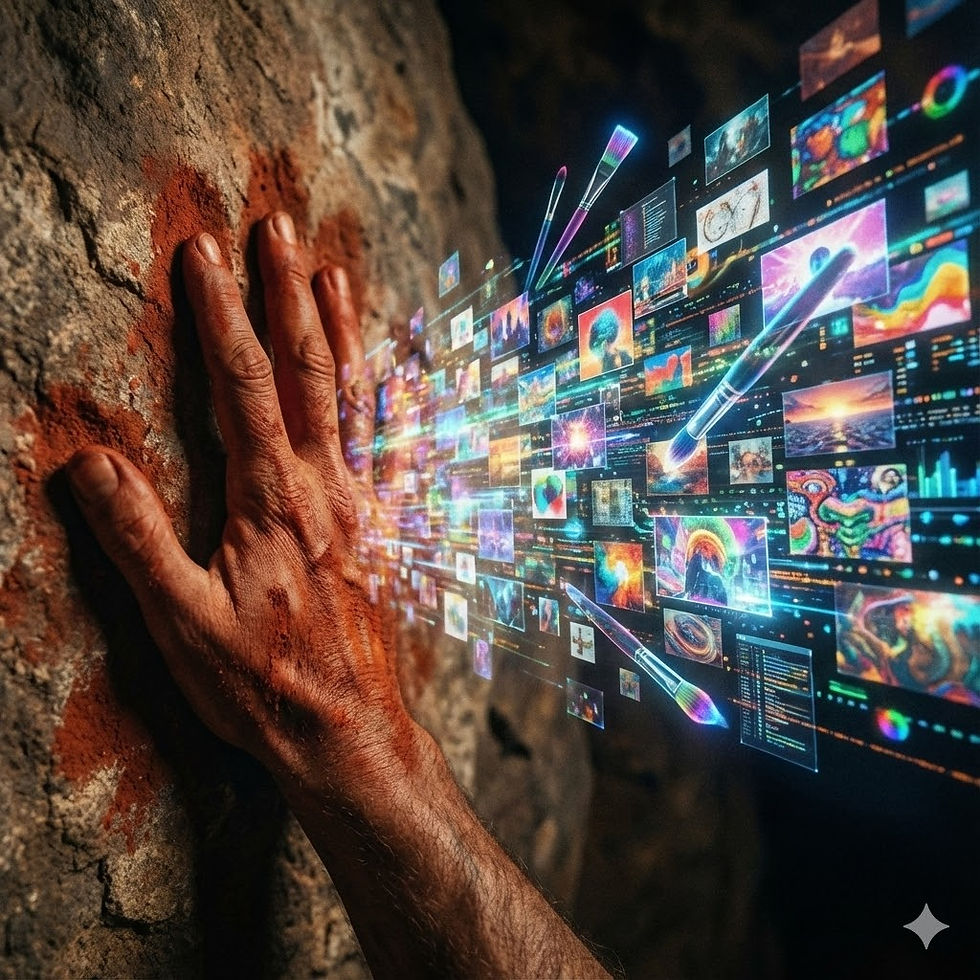
Today, Artificial Intelligence (AI) is emerging as perhaps the most revolutionary force yet in this domain, offering not just new tools but entirely new paradigms for creating, analyzing, and experiencing visual art. As AI begins to co-mingle with the human hand and eye, The Script That Will Save Humanity calls us to explore how this synergy can usher in a new era of enriched visual expression, democratized creativity, and deeper cultural understanding, all while navigating the complex ethical landscapes that these powerful new capabilities unveil.
This post delves into the exciting and challenging ways AI is impacting the world of visual art, from generating novel imagery to assisting human artists and reshaping our very definition of a masterpiece.
In this post, we visualize AI's impact on the visual arts:
🖌️ Algorithmic Canvases: AI as a Generator of Novel Visual Forms
🎨 The Augmented Studio: AI as an Intelligent Assistant for Visual Artists
✨ Immersive Spectacles: AI Crafting New Frontiers in Visual Experience
🏛️ Illuminating Legacies: AI in Analyzing and Preserving Visual Heritage
📜 Ethical Palette: "The Humanity Script" for AI in the Visual Arts
🖌️ 1. Algorithmic Canvases: AI as a Generator of Novel Visual Forms
AI, particularly through advanced generative and multimodal models, is demonstrating an astonishing ability to create original visual art, pushing the boundaries of aesthetics and imagination.
From Text Prompts to Pixel Masterpieces: State-of-the-art text-to-image and multimodal architectures translate complex textual prompts into high-resolution, stylistically diverse visuals—spanning oil paintings, concept illustrations, photorealistic scenes, and abstract compositions. This enables near-instantaneous visualization of ideas that once lived only in the creator's imagination.
AI Sculpting in Digital Dimensions: Generative spatial models now synthesize complex 3D meshes and neural radiance assets directly from text or 2D sketches. These assets are readily utilized in digital sculpting, spatial computing, animation, or physical fabrication via advanced multi-material 3D printing.
Prompt Architecture and Conceptual Direction: The craft of formulating nuanced visual prompts and negative constraints has matured into a recognized discipline, where human intent acts as the creative director guiding algorithmic synthesis toward specific emotional and aesthetic outcomes.
Exploring Vast Latent Possibilities: AI navigates multidimensional latent spaces to output countless thematic and stylistic variations in seconds, enabling artists to map vast creative territory far more quickly than traditional analog studies permit.
🔑 Key Takeaways:
Generative models translate complex language prompts into rich, high-fidelity 2D and 3D visual media.
Spatial AI accelerates digital sculpture, spatial asset design, and rapid physical prototyping.
Conceptual direction and prompt formulation have become vital skills in guiding generative engines.
Artists can rapidly iterate through hundreds of aesthetic variations to expand their conceptual scope.
🎨 2. The Augmented Studio: AI as an Intelligent Assistant for Visual Artists
Beyond autonomous generation, AI is proving to be an indispensable copilot in the studio, streamlining production bottlenecks and elevating the human creator's technical execution.
Intelligent Tools for Digital and Physical Craft: Creative software natively integrates neural assistance, offering dynamic brushes that adapt to pressure and stroke rhythm, automated perspective grids, lighting recalibration, and anatomical guidance. Physical painters utilize AI to generate complementary color harmonies and balance compositional weight before touching canvas.
Style Transfer and Aesthetic Remixing: Neural style transfer allows artists to extract textural qualities, brushstroke dynamics, and chromatic palettes from historical movements and merge them with contemporary subject matter, fostering innovative hybrid aesthetics.
Automating Repetitive Studio Tasks: Tedious technical chores—such as high-precision masking, background replacement, neural upscaling, artifact removal, and tonal grading—are resolved in seconds, freeing artists to invest their energy in high-level storytelling and conceptual depth.
Computational Photography: Modern photography pipelines leverage neural image reconstruction to eliminate noise in extreme low light, dynamically expand dynamic range, adjust depth of field post-capture, and intelligently preserve authentic skin textures.
🔑 Key Takeaways:
AI studio copilots provide real-time assistance with perspective, composition, and color harmonization.
Style transfer algorithms enable dynamic fusion between diverse art historical movements.
Automating technical workflows liberates artists to focus on emotional narrative and craft.
Computational photography pushes past the physical limitations of traditional optics and sensors.
✨ 3. Immersive Spectacles: AI Crafting New Frontiers in Visual Experience
AI is fundamentally redefining how audiences interact with art, dissolving the barrier between observer and exhibit.
Responsive and Interactive Installations: Spatial computing and computer vision enable large-scale gallery installations that react dynamically to visitor presence, body language, gaze direction, and ambient sound, turning the audience into an active participant shaping the artwork in real time.
Dynamic, Living Digital Canvases: Generative digital installations continuously evolve, drawing inputs from real-time environmental data, weather patterns, or social dialogue streams, ensuring that the artwork never manifests identically twice.
Adaptive Curation in Spatial Realities (VR/AR): In virtual galleries and augmented reality spaces, AI acts as an interactive docent, dynamically adjusting contextual narratives and thematic pathways based on an individual's demonstrated interests and aesthetic preferences.
Data Visualization as Fine Art: Neural networks translate complex environmental metrics, astronomical surveys, and societal patterns into deeply moving aesthetic spectacles, transforming abstract numerical data into emotionally resonant visual experiences.
🔑 Key Takeaways:
Computer vision powers interactive installations that evolve based on audience movement and engagement.
Digital canvases shift from static exhibits to living artworks informed by real-time data streams.
Spatial computing and AI create tailored, interactive encounters in virtual and augmented gallery spaces.
Data art transforms dense scientific and cultural metrics into striking visual narratives.
🏛️ 4. Illuminating Legacies: AI in Analyzing and Preserving Visual Heritage
Art historians, conservators, and cultural institutions are leveraging machine learning to safeguard, analyze, and restore humanity’s shared visual archives.
Micro-Stylistic Analysis and Attribution: Neural networks trained on millions of brushstrokes assist conservators in tracing an artist's technique over time, identifying underdrawings in pentimento layers, and providing objective metrics for authenticating disputed masterpieces.
Non-Invasive Digital Restoration: Machine learning models reconstruct damaged frescoes, faded tapestries, and degraded historical photographs. By analyzing surrounding chemical pigments and historical archival references, AI digitally repairs fractures and restores authentic color palettes without touching physical artifacts.
Semantic Archival Discovery: Computer vision algorithms catalog massive museum archives, tagging visual motifs, transcription fragments, and stylistic elements to make millions of previously unindexed cultural works searchable for researchers globally.
Algorithmic Forgery Detection: Machine learning identifies microscopic inconsistencies in canvas weave, pigment composition, and stroke hesitation, giving institutions powerful defenses against sophisticated art market forgeries.
🔑 Key Takeaways:
AI models assist experts with attribution and brushstroke authentication in disputed artworks.
Non-invasive algorithms digitally restore decayed, damaged, and faded cultural treasures.
Computer vision organizes and unlocks global museum archives through semantic indexing.
Algorithmic analysis provides high-precision detection of illicit forgeries and reproductions.
📜 5. Ethical Palette: "The Humanity Script" for AI in the Visual Arts
The extraordinary capabilities of generative visual tools must be governed by an unwavering ethical architecture. The Script That Will Save Humanity establishes vital imperatives for the visual arts:
Protecting Copyright, Consent, and Preventing "Style Theft": Foundational training models must respect artist sovereignty. Scraping living artists' catalogs without explicit opt-in consent or fair market compensation is unethical. Clear legal frameworks must protect individual creators from unauthorized algorithmic emulation of their signature style.
Mitigating Algorithmic Bias and Monoculture: Generative visual models trained on uncurated datasets often reproduce narrow beauty standards, Western-centric aesthetics, and harmful social stereotypes. Continuous algorithmic auditing and diverse, globally representative datasets are required to safeguard visual pluralism.
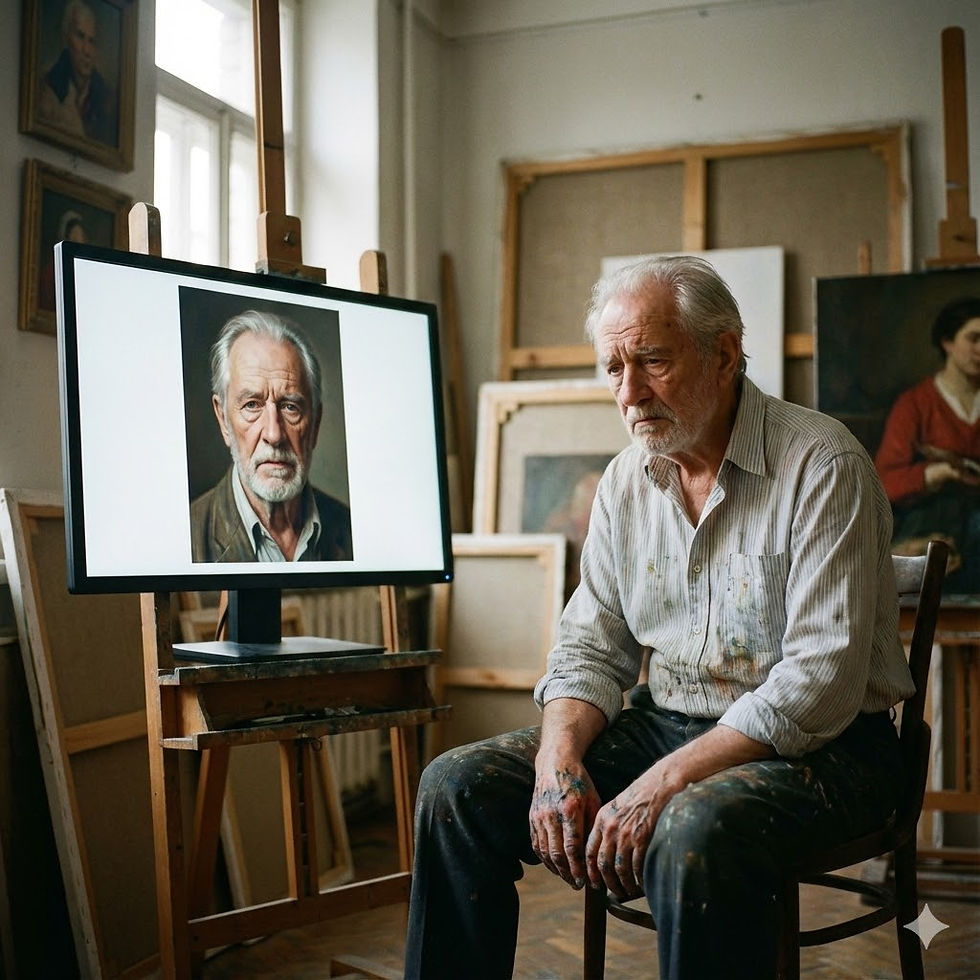
The Sanctity of the "Artist's Hand": As synthetic imagery becomes indistinguishable from traditional media, cultural institutions and audiences must continue to celebrate the human vulnerability, physical effort, and philosophical intent behind authentic human artistry.
Countering Deepfakes and Synthetic Misinformation: Hyper-realistic synthetic images threaten visual truth. Platforms and creators must integrate cryptographically verifiable provenance standards (such as C2PA metadata) and robust watermarking to ensure accountability and prevent visual deception.
Sustaining Professional Livelihoods: The rapid automation of commercial illustration, concept design, and commercial photography requires proactive economic adaptation, royalty sharing for training data, and renewed industry investment in human-led creativity.
Cultivating Critical Visual Literacy: Society must develop nuanced critical visual literacy to distinguish authentic photographic documentation from synthetic artifacts, ensuring that the proliferation of generative imagery does not erode public trust.
🔑 Key Takeaways:
The "script" demands explicit consent, fair compensation, and protection against unauthorized style theft.
Continuous auditing is necessary to dismantle biased representations and prevent visual monoculture.
Mandatory cryptographic provenance (C2PA) and transparent labeling are critical to counter synthetic misinformation.
Economic models must prioritize sustaining the livelihoods and unique contributions of human artists.
✨ AI and the Visual Arts – Co-Creating a More Vivid and Conscious Future
Artificial Intelligence is opening a transformative frontier for visual culture, providing creators and audiences with visionary instruments to imagine, explore, and preserve the visual world. From expanding the exploratory boundaries of the studio to unearthing the subtle brushstrokes of historical masterpieces, AI is reshaping the visual arts from the ground up.
The Script That Will Save Humanity reminds us that technology must serve to dignify and elevate human expression, never to diminish it. By wielding these tools with ethical conviction, demanding transparency, and honoring the enduring spirit of human craft, we can co-create a visual culture that is richer, more inclusive, and deeply attuned to our shared human experience.
💬 What are your thoughts?
Which application of AI in visual art—real-time generative installations, intelligent studio tools, or heritage preservation—excites you most?
What regulatory or industry measures are most crucial to protect living artists from non-consensual algorithmic style cloning?
How can art educators and institutions best preserve the cultural and philosophical value of the human "artist's hand" in an era of automated visual generation?
Join the conversation and share your perspectives in the comments below! 👇
📖 Glossary of Key Terms
AI Visual Art: 🖼️🤖 Visual media (paintings, digital illustrations, sculptures, photography) created with significant algorithmic participation or autonomous generative modeling.
Generative Diffusion Models: ✨👁️ Deep learning architectures that generate high-fidelity imagery by iteratively reversing a noise-addition process based on learned pattern distributions.
Text-to-Image AI: ✍️➡️🖼️ Algorithmic pipelines that translate natural language descriptions into coherent visual scenes, styles, and subjects.
Style Transfer: 🎨🔄 A computer vision technique that isolates the stylistic traits (textures, brushwork, chromatic palette) of one artwork and applies them to another image.
Ethical AI Visuals: ❤️🩹👁️ Governance standards prioritizing artist consent, copyright attribution, fair compensation, anti-bias testing, and content provenance in digital media.
Deepfake Imagery: 🎭🖼️ Synthetic images or videos generated by neural networks that convincingly fabricate human likenesses, events, or environments with intent to deceive.
Content Provenance (C2PA): 🔒 Cryptographic standards that verify the origin, edit history, and generative AI tools utilized in creating digital imagery.
Computational Photography: 💻📸 Digital image capture and processing pipelines that utilize neural networks to optimize lighting, depth, and clarity beyond standard lens physics.
Latent Space Navigation: 🧭🎨 The process of exploring and interpolating mathematical coordinates within an AI model's internal data representations to discover novel visual compositions.

Posts on the topic 🎨 AI in Arts and Creativity:
Finish Beethoven's Symphony: Music Co-Created with Geniuses of the Past
The AI Artist: A Threat to the "Inner Compass" or Its Best Tool?
Artistic Avenues Square Up: Digital Art (NFTs) vs. Traditional Canvas
Creative AI: 100 Tips & Tricks for Arts & Innovation
Arts & Creativity: 100 AI-Powered Business and Startup Ideas
Arts and Creativity: AI Innovators "TOP-100"
Arts and Creativity: Records and Anti-records
Arts and Creativity: The Best Resources from AI
Statistics in Arts and Creativity from AI
The Role of AI in Preserving and Presenting Cultural Heritage
AI in Writing and Literature
AI in Music Composition and Performance
How is AI changing the way we perceive Art?
What does the Future hold for Art in the age of AI?
The Best AI Tools for Photos
The Best Image Generation
New Art Forms Powered by AI: Blurring the Lines of Creativity
The Future of AI in Art: A Canvas of Possibilities
An Exhaustive Examination of the Problems of AI in Art
AI's Creative Canvas: Exploring the Diverse Applications of AI in Art
Possibilities of AI in Art
Visual Art and AI: A New Era of Creativity
Art and AI: Symbiosis Creating New Horizons
Explore our Top-rated AI applications across all industries
⚕️ AI in Medicine and Healthcare
⚖️ AI in Jurisprudence
🧑💼 AI in Human Resources
📈 AI in Business and Finance
🚚 AI in Transportation & Logistics
🏭 AI in Manufacturing and Industry
🛍️ AI in Retail and E-commerce
🌿 AI in Agriculture
🛡️ AI in Security and Defense
🔋 AI in Energy
🔬 AI in Scientific Research
🚀 AI in Space Industry
🌐 AI in Telecommunications
🎯 AI in Advertising and Marketing
🏗️ AI in Construction
🏙️ AI in Urban Studies
🌦️ AI in Meteorology

This is a fascinating look at how AI is changing the world of art! I'm amazed by the creative potential of tools like DALL-E and Midjourney. The discussion about AI's role in art raises important questions – I'm curious to see where this intersection of technology and creativity will take us.