
New Art Forms Powered by AI: Blurring the Lines of Creativity
Updated: 4 days ago
🎨 Aiwa-AI Perspective ✨
Beyond the Canvas: "The Script That Will Save Humanity" Exploring AI-Native Art and the Future of Creative Expression
Brief Summary: Art is transitioning from static observation to dynamic interaction. This post explores the rise of "AI-Native" art forms, including real-time generative canvases that evolve based on audience biometric feedback and immersive, algorithmic bio-art. However, The Script That Will Save Humanity provides a crucial ethical anchor: we must ensure these new mediums do not degenerate into an "algorithmic monoculture" controlled by a few tech giants. Furthermore, we must establish new frameworks for intellectual property in co-created spaces and guarantee equitable global access so this new creative frontier remains universally inclusive.*
The history of art is a chronicle of continuous evolution, a vibrant dance between human imagination and the ever-expanding toolkit of creation. From the earliest pigments to the digital pixel, new technologies have consistently unlocked novel forms of expression and reshaped our understanding of what art can be.
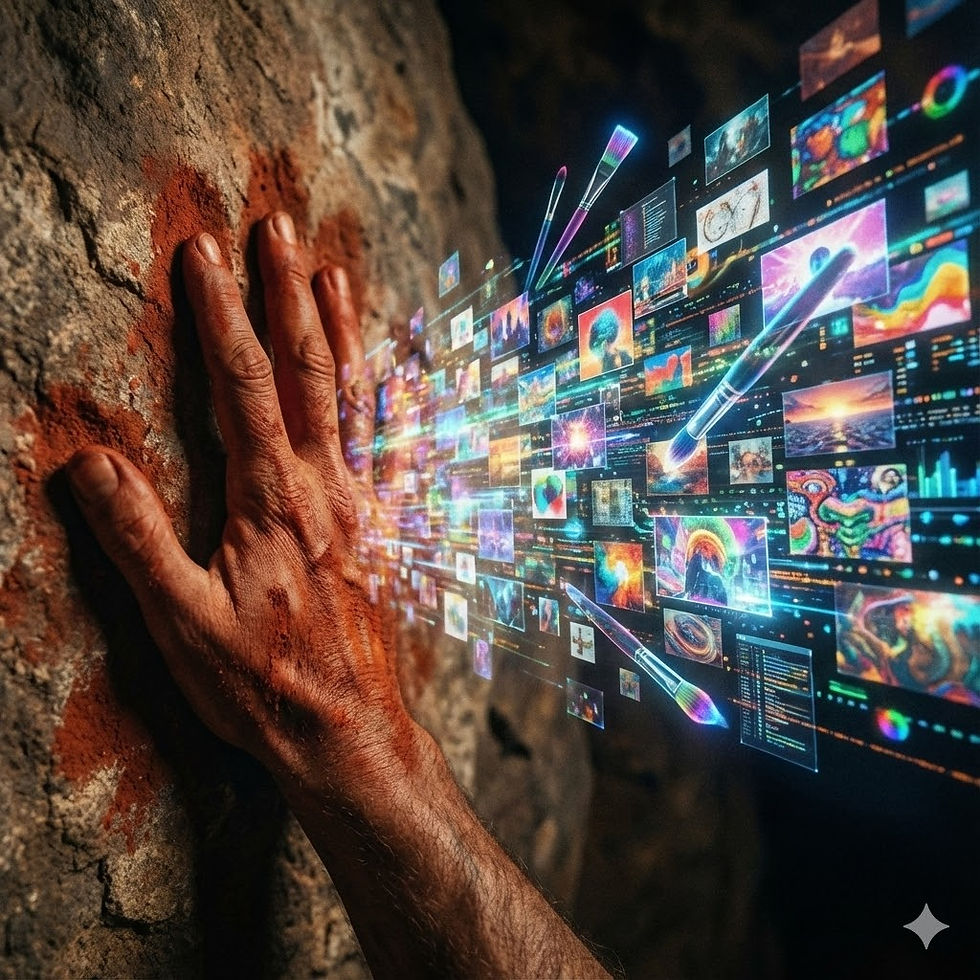
Today, Artificial Intelligence (AI) is not merely offering artists another tool; it's emerging as a potent catalyst, giving rise to entirely new, AI-native art forms that profoundly blur the traditional lines of creativity, authorship, and even the artistic experience itself. As we stand at this fascinating intersection, The Script That Will Save Humanity calls us to engage with these emergent forms with curiosity and critical thought, exploring how they can enrich human culture, foster new types of understanding and connection, and what new responsibilities they bring for creators, audiences, and society at large.
This post ventures into the burgeoning landscape of new art forms powered by AI, where the boundaries of creativity are being redrawn before our very eyes.
In this post, we explore the emerging artistic landscape shaped by AI:
🤖 Algorithmic Canvases: Generative Art Where Code is King
🤝 Interactive Realms: AI Crafting Living, Responsive Art
🧬 Bio-Art & Algorithmic Nature: Exploring Life's Code as Art
🌐 Immersive Worlds: AI-Native Art in Spatial Realities
📜 Ethical Frontiers: "The Humanity Script" for AI's New Terrains
🤖 1. Algorithmic Canvases: Generative Art Where Code is King
At the forefront of AI's artistic impact is generative art, where algorithms, often guided by human prompts or datasets, become primary authors of aesthetic experiences.
Art Born from Data and Prompts: Sophisticated AI models, such as Generative Adversarial Networks (GANs) and diffusion models, can create stunningly original visual art, intricate patterns, and novel designs based on textual prompts, existing image datasets, or evolving rule sets. The "artist's" role often shifts to that of a prompter, curator, or collaborator with the algorithm.
The Aesthetics of Algorithmic Creation: This art form often exhibits unique characteristics—infinite variability, emergent complexity, a blend of predictability and serendipity, and sometimes an "otherness" that distinctly signals its non-human origin, challenging our conventional aesthetic sensibilities.
Beyond Visuals - Algorithmic Music and Narrative: Generative AI is also composing original music that can adapt and evolve, writing poetry or prose with distinct styles, and even creating procedural narratives or game worlds where the story and environment are algorithmically generated, offering endless unique experiences.
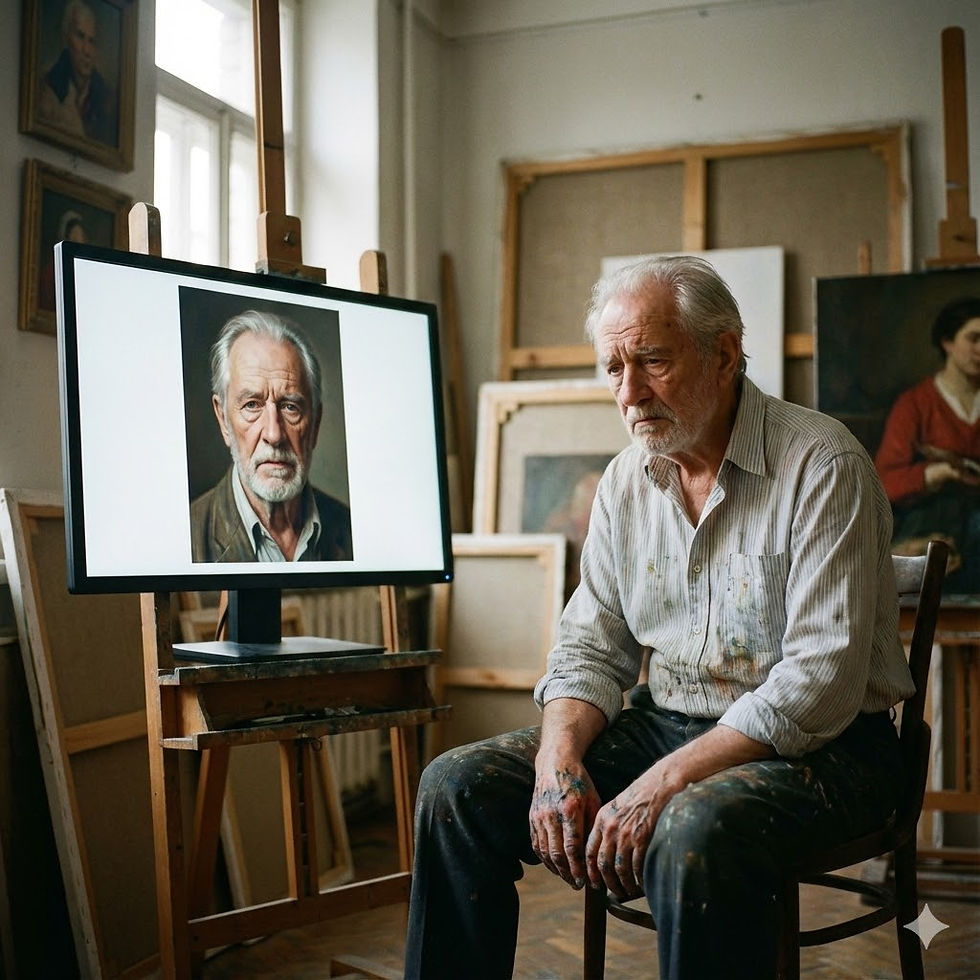
Blurring Authorship: The line between human artist and AI tool becomes increasingly blurred. Is the AI a sophisticated brush, or a creative entity in its own right? This redefines our perception of where artistic agency lies.
🔑 Key Takeaways:
AI algorithms can autonomously generate novel visual art, music, and narrative structures.
Algorithmic art often possesses unique aesthetics characterized by complexity and emergent behavior.
Generative AI significantly blurs the traditional lines of authorship and artistic agency.

🤝 2. Interactive Realms: AI Crafting Living, Responsive Art Experiences
AI is enabling art to break free from static forms, becoming dynamic, living experiences that engage audiences in unprecedented ways.
Art That "Feels" and Responds: AI can power interactive art installations that react to the presence, movements, gestures, or even inferred emotional states (via sensors and AI analysis, with ethical considerations) of the audience. The artwork changes, adapts, and evolves in response to the viewer, making them an integral part of its manifestation.
Data-Driven, Ever-Changing Artworks: Imagine artworks that are constantly fed real-time data streams—environmental conditions, social media sentiment, stock market fluctuations, news headlines—and use AI to transform this data into evolving visual, auditory, or kinetic art pieces. The art becomes a living commentary on the world around it.
The Audience as Co-Creator: In these interactive forms, the traditional distinction between artist, artwork, and audience dissolves. Viewers become active participants, co-creators whose engagement directly shapes the artistic experience, leading to a deeply personalized and often unrepeatable encounter.
🔑 Key Takeaways:
AI enables interactive art installations that respond to audience presence and behavior.
Artworks can dynamically evolve based on real-time data streams processed by AI.
The viewer often becomes a co-creator, blurring the lines between audience and artwork.

🧬 3. Bio-Art & Algorithmic Nature: AI Exploring Life's Code as Art
The intersection of AI, biology, and art is giving rise to fascinating and thought-provoking new forms of expression that explore the very essence of life and natural processes.
AI Interpreting Biological Data as Art: AI algorithms can analyze complex biological data—such as genomic sequences, protein structures, cellular imagery, or brainwave patterns—and translate these into novel visual or sonic art forms, offering new aesthetic interpretations of life's intricate code.
Speculative Synthetic Biology and Art: While still nascent, artists and scientists are exploring how AI could assist in designing or simulating synthetic biological systems or organisms with specific aesthetic properties or behaviors, raising profound questions about the nature of life and creation.
Reflecting on Natural Systems through an AI Lens: AI can model and simulate natural processes (e.g., flocking behavior, plant growth, ecosystem dynamics) which artists then use as a basis for generative artworks that reflect on the beauty, complexity, and fragility of the natural world, often with a unique algorithmic perspective.
🔑 Key Takeaways:
AI can translate complex biological data into novel artistic visual or sonic forms.
It is being explored in speculative bio-art, potentially assisting in designing aesthetic biological systems.
AI-driven art can offer unique reflections on natural processes and the patterns of life.

🌐 4. Immersive Worlds: AI-Native Art in Virtual and Augmented Realities
As virtual and augmented realities become more sophisticated, AI is playing a crucial role in creating entirely new artistic forms native to these immersive environments.
Art Beyond Physical Constraints: AI can generate vast, intricate, and dynamically changing artistic environments specifically designed for VR and AR platforms. These are worlds unbound by physical limitations, where the laws of physics and materiality can be reimagined.
Responsive and Intelligent Virtual Inhabitants: AI can populate these immersive art worlds with intelligent virtual characters or entities that interact with users in complex and unpredictable ways, creating personalized and emergent narrative or aesthetic experiences.
Personalized and Shared Immersive Journeys: AI can tailor immersive artistic experiences to individual user preferences or enable shared, collaborative art-making and exploration within virtual spaces, blurring the lines between individual perception and collective creation.
🔑 Key Takeaways:
AI generates dynamic and infinitely explorable artistic environments for VR and AR.
It can populate these immersive worlds with intelligent, interactive virtual entities.
AI enables personalized and shared immersive artistic experiences, transcending physical limitations.

📜 5. Ethical Frontiers: The Script That Will Save Humanity for Navigating AI's New Artistic Terrains
The emergence of these new AI-powered art forms is exhilarating, but The Script That Will Save Humanity requires us to navigate these uncharted territories with ethical foresight and a deep consideration for human values.
Redefining "Art," "Artist," and "Creativity": As AI becomes capable of producing outputs that are aesthetically compelling and conceptually novel, we are forced to re-examine our fundamental definitions. What constitutes "art" if it is not solely human-originated? What is the role of the "artist" in an age of co-creation with intelligent machines? The "script" calls for an evolving, inclusive, yet discerning understanding.
Authorship, Ownership, and the Value of AI-Native Art: Who owns the intellectual property of these new art forms, especially those that are interactive, generative, or co-created with significant AI input? How are they valued culturally and economically? New models for IP, attribution, and market valuation are urgently needed.
Ensuring Accessibility and Preventing a New "Art Divide": These advanced AI tools and the skills to use them effectively must not become the exclusive domain of a technological elite. The "script" calls for efforts to democratize access, ensuring diverse creators and audiences worldwide can participate in and benefit from these new artistic possibilities.
Guarding Against Aesthetic Homogenization: If many new art forms rely on a limited set of popular AI models or are trained on similar massive datasets, there is a risk of an "algorithmic monoculture" or a new kind of aesthetic conformity. How can AI be steered to foster genuinely diverse, experimental, and even radical artistic innovation?
Emotional Resonance and Conveying Human Meaning: A central question remains: can these new AI-powered art forms consistently evoke the same depth of emotional connection, convey profound human meaning, or provoke critical thought as art born from direct human experience and struggle? Exploring how the "human element" persists, transforms, or is newly defined is crucial.
Authenticity in a World of Synthetic Media: The increasing sophistication of AI in generating art also blurs the lines of authenticity, making it harder to distinguish human from machine-made, or original from derivative. The challenge of "deepfake art" or an overabundance of low-effort AI creations requires new forms of curation and critical engagement.
🔑 Key Takeaways:
The "script" requires us to thoughtfully redefine concepts of art, artist, and creativity.
It calls for new models of IP and valuation, and a commitment to democratizing access to creative tools.
Guarding against aesthetic homogenization, ensuring emotional resonance, and navigating authenticity are key ethical challenges.

✨ AI as a Co-Pilot into Uncharted Artistic Territories
Artificial Intelligence is not merely an observer or an analyst in the world of art; it is rapidly becoming an active participant, a co-creator, and a catalyst for entirely new forms of creative expression that are blurring traditional boundaries and expanding our understanding of what art can be. From generative algorithms that paint with data to interactive installations that respond to our very presence, AI is opening up uncharted artistic territories.
The Script That Will Save Humanity encourages us to embrace this profound evolution with both intellectual curiosity and unwavering ethical vigilance. It's about fostering an environment where these nascent art forms can flourish, enrich human culture, challenge our perceptions, and offer new avenues for understanding ourselves and the universe. The future of art, in this age of AI, promises a vibrant and dynamic landscape where human ingenuity and algorithmic intelligence engage in a continuous dialogue, co-piloting us towards an even more diverse, immersive, and thought-provoking global artistic tapestry.
💬 What are your thoughts?
Which of these emerging AI-powered art forms do you find most intriguing or potentially transformative? Why?
As AI blurs the lines of creativity, how should we, as a society, redefine concepts like "artist" and "originality"?
What ethical responsibilities do creators, curators, and consumers have when engaging with these new AI-native art forms?
Join the conversation as we explore the exciting and evolving frontiers of art in the age of AI in the comments below! 👇
📖 Glossary of Key Terms
AI-Native Art: 🤖🎨 Art forms that are fundamentally dependent on Artificial Intelligence for their creation, manifestation, or experience, often existing in digital or interactive realms.
Generative Art: ✨🖼️ Art created, in whole or in part, through the use of an autonomous system, typically an algorithm or AI model, that follows a set of rules or learns from data to produce novel outputs.
Algorithmic Art: 🔢🎭 Art where the design is generated by an algorithm, often emphasizing the beauty of mathematical patterns, computational processes, or emergent complexity.
Interactive AI Art: 🤝🏽💡 Artworks that use AI to sense and respond to audience presence, interaction, or environmental data, making the viewer an active participant in the piece.
Bio-Art (AI-influenced): 🧬🌱 An art practice where artists work with live tissues, bacteria, living organisms, and life processes, with AI potentially used for analysis, design, or simulation of biological systems for artistic expression.
VR/AR Art (AI): 🕶️🌐 Art created for and experienced within Virtual Reality or Augmented Reality environments, where AI can be used to generate dynamic content, create intelligent virtual characters, or personalize immersive experiences.
Ethical AI Art Forms: ❤️🩹🎨 Moral principles and considerations specifically addressing the creation, dissemination, ownership, and societal impact of new art forms significantly powered or generated by AI.
Computational Creativity: 💻🧠 A multidisciplinary field at the intersection of AI, cognitive science, philosophy, and the arts, focused on building and understanding computational systems that exhibit creative behavior.

Posts on the topic 🎨 AI in Arts and Creativity:
Finish Beethoven's Symphony: Music Co-Created with Geniuses of the Past
The AI Artist: A Threat to the "Inner Compass" or Its Best Tool?
Artistic Avenues Square Up: Digital Art (NFTs) vs. Traditional Canvas
Creative AI: 100 Tips & Tricks for Arts & Innovation
Arts & Creativity: 100 AI-Powered Business and Startup Ideas
Arts and Creativity: AI Innovators "TOP-100"
Arts and Creativity: Records and Anti-records
Arts and Creativity: The Best Resources from AI
Statistics in Arts and Creativity from AI
The Role of AI in Preserving and Presenting Cultural Heritage
AI in Writing and Literature
AI in Music Composition and Performance
How is AI changing the way we perceive Art?
What does the Future hold for Art in the age of AI?
The Best AI Tools for Photos
The Best Image Generation
New Art Forms Powered by AI: Blurring the Lines of Creativity
The Future of AI in Art: A Canvas of Possibilities
An Exhaustive Examination of the Problems of AI in Art
AI's Creative Canvas: Exploring the Diverse Applications of AI in Art
Possibilities of AI in Art
Visual Art and AI: A New Era of Creativity
Art and AI: Symbiosis Creating New Horizons
Explore our Top-rated AI applications across all industries
⚕️ AI in Medicine and Healthcare
⚖️ AI in Jurisprudence
🧑💼 AI in Human Resources
📈 AI in Business and Finance
🚚 AI in Transportation & Logistics
🏭 AI in Manufacturing and Industry
🛍️ AI in Retail and E-commerce
🌿 AI in Agriculture
🛡️ AI in Security and Defense
🔋 AI in Energy
🔬 AI in Scientific Research
🚀 AI in Space Industry
🌐 AI in Telecommunications
🎯 AI in Advertising and Marketing
🏗️ AI in Construction
🏙️ AI in Urban Studies
🌦️ AI in Meteorology

I saw an installation last week that was generating video in real-time based on the crowd's noise levels.
Honestly? It was trippier than any painting I’ve ever seen.
I don’t know if I’d call it 'art' in the classical sense—there was no painter, just code—but I stood there for 40 minutes just staring at it. Whatever this new form is, it definitely grabs you.
I'm fascinated by the ways AI is transforming art! It raises so many interesting questions about creativity and the role of technology in the artistic process. I'm excited to see how these new art forms will evolve and what amazing things artists will create with AI tools.