
From Cave Paintings to the Infinite Canvas: The Democratization of Creativity
Updated: 4 days ago
🎨 Aiwa-AI Perspective: The Architect of Dreams
Art is the biological language we use to speak to the future and to each other. For millennia, this sacred language was heavily bottlenecked by physical technical skill—if your biological hand trembled, or if you couldn't afford expensive pigments, your profound vision remained permanently trapped inside your skull.
At Aiwa-AI, we believe that Artificial Intelligence is the ultimate, unstoppable democratizer of human creativity. It aggressively dissolves the physical barrier between 'Idea' and 'Execution.' The algorithmic machine absolutely does not replace the biological Artist; it acts as an infinite Muse and a tireless Apprentice, allowing every single human soul to paint, compose, and direct with the pure speed of thought.
In this post, we explore:
1. 📜 The Grand Timeline: From the Ochre Handprint to the Generative Prompt.
2. 📷 The Lesson of the Camera: Why the Lens Didn't Kill the Brush.
3. 🧠 The Hallucinating Machine: Surrealism 2.0.
4. 🎼 The Symphony of One: The Producer in the Box.
5. 🛡️ The Humanity Script: The Soul of the Imperfect.
6. ✨ The Humanity-Saving Scenario: The Creative Provenance Act.
📜 1. The Grand Timeline: The Tools of Expression
The entire history of art is indistinguishable from the history of technology. The invention of paint in a metal tube (1841) allowed the Impressionists to physically leave their studios and paint outside. The invention of the camera (1839) violently forced painters to completely abandon realism in favor of abstraction.
🏛 Era I: The Age of Pigment (The Hand - ~68,000 B.C.-1800s)
The Paradigm: Art is intensely physical, highly scarce, and restricted by biology.
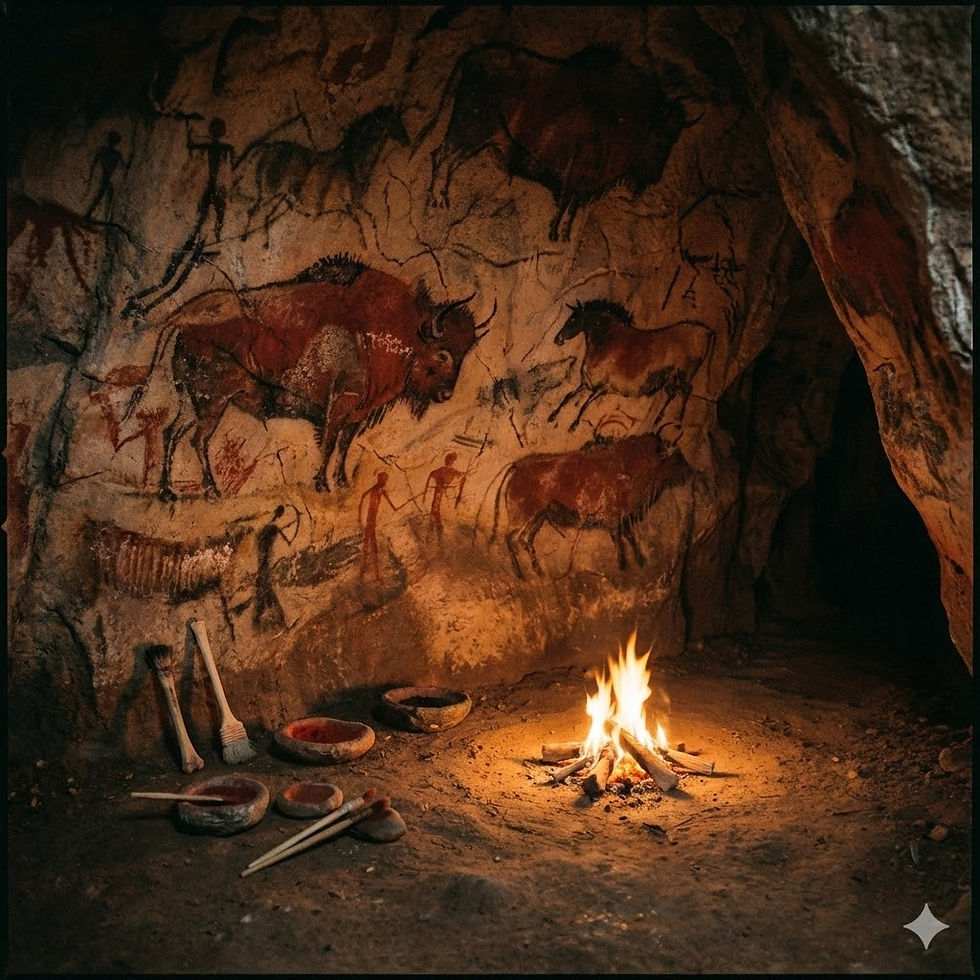
~68,000 B.C. — The Cave Handprint: The absolute birth of the human ego in Indonesia and beyond. The primal, biological desire to leave a permanent mark.
1400s — The Renaissance: The brilliant mathematical invention of linear perspective and oil paint. Art briefly becomes a strict science of flawlessly replicating reality.
1841 — The Paint Tube: John Goffe Rand invents the collapsible tin paint tube. Claude Monet can now travel. Impressionism is instantly born from mobility.

⚙️ Era II: The Age of the Lens (The Eye - 1800s-1900s)
The Paradigm: The machine captures physical reality vastly better than the biological hand.
1839 — The Daguerreotype: Photography is invented. Terrified critics instantly panic, declaring: "From today, painting is dead." Instead, painting is beautifully liberated from boring realism and violently moves toward Cubism and Abstract art.
1917 — Duchamp’s Fountain: Marcel Duchamp places an upside-down porcelain urinal in a gallery. He fiercely argues that Selection is art. The raw idea suddenly matters vastly more than the manual craft.
💻 Era III: The Age of the Pixel (The Undo Button - 1980s-2010s)
The Paradigm: Art becomes mathematically editable and perfectly forgiving.
1987 — Photoshop 1.0: Digital art introduces transparent layers and the miraculous "Undo" button. Humans can infinitely manipulate reality without physical mess or permanent mistakes.

🤖 Era IV: The Age of Generation (The Prompt - 2010s-2030s)
The Paradigm: The machine imagines alongside the human.
2015 — DeepDream: Google's AI mathematically "hallucinates" grotesque dogs and eyes into images of landscapes. It’s psychedelic and bizarre, but it conclusively proves the neural net possesses an alien aesthetic.
2022 — Midjourney & DALL-E 2: The Absolute Turning Point. High-fidelity Text-to-Image models. A breathtaking digital illustration that used to require 10 hours of manual labor now takes 10 seconds of compute.
2024 — Suno & Udio: Text-to-Music. Generative AI creates full, radio-quality songs with synthesized vocals and instrumentals that are mathematically indistinguishable from biological human recordings.
2030 (Prediction) — The Dream Interface: Direct Brain-Computer Interface (BCI) art generation. You biologically visualize a chaotic scene, and the screen renders it instantly from your visual cortex. Absolutely no keyboard required.
🔑 Key Takeaways:
Every major leap in art history was triggered by a disruptive technological tool.
Generative AI separates the creative vision from the requirement of manual labor.
The evolution of art moves continuously toward lowering the friction between imagination and reality.
📷 2. The Lesson of the Camera
In 1850, the legendary French poet Charles Baudelaire aggressively dismissed photography, calling it "the refuge of every would-be painter, every painter too ill-endowed or too lazy to complete his studies."
The Parallel: Today, terrified critics say the exact same thing about Generative AI. "It's cheating. It's theft. You didn't physically paint it."
The Reality: Just as the camera successfully birthed entirely new, brilliant art forms (Cinema, Photojournalism, Documentary) and actively pushed traditional painting into thrilling new territories (Abstract Expressionism), AI will inevitably create dynamic new genres we cannot even neurologically imagine yet. It forces humans to permanently stop being "Human Photocopiers" and finally start being "Human Dreamers."
🔑 Key Takeaways:
Historical backlash against AI art perfectly mirrors the 19th-century backlash against photography.
Disruptive tools do not kill creativity; they force traditional mediums to evolve.
AI elevates the human role from manual execution to high-level conceptual direction.
🧠 3. The Hallucinating Machine
A diffusion model absolutely does not biologically "know" what a cat looks like. It only knows the high-dimensional mathematical probability of a cat-like shape emerging from digital static.
Surrealism 2.0 (The Glitch Aesthetic): When an AI makes a massive statistical mistake (generating a human hand with 7 fingers, or a skyscraper that seamlessly melts into a flock of birds), it accidentally creates a profound "dream-logic." Cutting-edge human artists are now actively forcing these hallucinations intentionally to create unsettling, alien landscapes.
Style Transfer: A biological artist can effortlessly ask: "Show me Star Wars directed by Wes Anderson." The AI mathematically merges two entirely distinct aesthetic universes instantly in the latent space, allowing for impossibly rapid stylistic exploration that would take a human lifetime to paint by hand.
🔑 Key Takeaways:
Generative AI creates images through probability and noise reduction, not biological understanding.
Algorithmic "mistakes" are birthing a new genre of digital surrealism.
Style transfer allows creators to infinitely remix existing cultural aesthetics.
🎼 4. The Symphony of One
Historically, musical composition was easily the most highly gated art form on Earth. You desperately needed to know complex mathematical notation, study advanced music theory, and physically hire a 60-piece biological orchestra to hear your idea.
The Producer in the Box (Accessibility): Today, a teenager living in poverty who has a brilliant symphony in their head but zero access to expensive piano lessons can hum a crude melody into an AI model. The algorithm flawlessly expands it, harmonizes it, and outputs a mastered, multi-track symphony.
The Fear: Will Spotify and Apple Music be violently flooded with terabytes of mediocre, low-effort "AI sludge"? Absolutely. Yes. But the mathematical reality is that the next Mozart might be a child who creates a world-changing masterpiece using an AI prompt, simply because they couldn't afford a physical violin.
🔑 Key Takeaways:
AI completely destroys the financial and educational barriers to musical composition.
While it will flood the market with mediocre content, it simultaneously unearths hidden genius.
The definition of a "musician" shifts from instrumental proficiency to auditory curation.

🛡️ 5. The Humanity Script: The Soul of the Imperfect
If a server farm can generate mathematically "perfect", hyper-realistic beauty in four seconds, why will biological humans still care about human-made art?
The Humanity Script:
Process over Product: We deeply value a flawed, hand-knitted physical scarf not because it's mathematically warmer than a machine-made one, but precisely because a biological human traded their finite, mortal time to make it. In the algorithmic age, the biological "Labor of Love" becomes the ultimate premium luxury value.
The Biography: We obsess over Vincent Van Gogh's paintings entirely because we know his agonizing, tragic biological story. AI has no story. It has no physical pain. It has no mortality. Without the crushing weight of a human biography behind it, generated art is often just beautiful, empty decoration.
Copyright & Ethics: We must violently protect human artists from having their lifetime of style mechanically strip-mined. If an AI model is commercially trained on a living artist's copyrighted work, that biological artist must be financially compensated.
🔑 Key Takeaways:
As perfect synthetic art becomes infinite and free, flawed biological art becomes a premium luxury.
The narrative and pain of the human artist provide the emotional anchor that AI mathematically lacks.
We must establish strict legal frameworks to protect the intellectual property of biological creators.
✨ 6. The Humanity-Saving Scenario: The Creative Provenance & Artist Sovereignty Act
If we allow tech monopolies to ruthlessly scrape every painting, song, and photograph ever created by a biological human, grind it down into training data, and sell it back to us as a subscription service, we will mathematically destroy the economic survival of the human artist. Without artists, culture stagnates into an endless, algorithmic remix of the past. To ensure the infinite canvas remains an instrument of human liberation rather than a tool for corporate theft, we must actively architect the Humanity-Saving Scenario.
This scenario dictates the international legislative ratification of the Creative Provenance and Artist Sovereignty Act. Anticipating the European Parliament's 2025/2026 push for AI copyright frameworks, this Act legally mandates a global "Opt-Out/Opt-In Licensing Registry" maintained by international IP offices.
It makes it a severe federal crime for any tech conglomerate to train a generative model on copyrighted material without explicit cryptographic consent and direct, recurring royalty payments to the biological creator. Furthermore, the Act mandates absolute "Algorithmic Transparency"—requiring all synthetic media to carry an unbreakable, cryptographic digital watermark explicitly detailing the training data utilized, ensuring biological art is forever distinguishable from synthetic output. By legally separating the human creator from the algorithmic engine, we ensure the democratization of creativity does not end in the starvation of the artist.
🗣️ Over to You: The Infinite Canvas
We have permanently moved from the desperate Ochre Handprint—a fragile sign of physical presence—to the Infinite Canvas—a towering monument to mental expansion. AI absolutely does not kill Art. It ruthlessly kills the excuse that you are not physically talented enough to create it. Now, the absolute only limit is the courage of your own imagination.
The Betrayal: If you discovered that your absolute favorite, most emotionally devastating song was actually mathematically generated by an AI, would you instantly stop loving it?
The Process: Is "Prompt Engineering" (typing text into a text box) a genuine, biological form of art, or just a sophisticated Google search?
The Gallery: Would you physically pay money to go to a real-world museum to exclusively see art generated by a server farm, or do you require human pain behind the canvas?
Outline your perspective on implementing the Humanity-Saving Scenario to establish the Creative Provenance Act. We invite you to share your insights and join this critical battle for the soul of art in the comments below! 👇
📖 Glossary of Key Terms
Generative AI: 🎨 A powerful class of neural networks that can mathematically create entirely novel, high-fidelity content (images, audio, video) rather than simply analyzing existing data.
Prompt Engineering: 📝 The highly technical, linguistic art of crafting precise text inputs to mathematically force a latent AI model to output a highly specific aesthetic vision.
Hallucination (Aesthetic): 🥴 In AI art, when the mathematical model generates bizarre elements that defy physics (like melting architecture or extra limbs), often utilized creatively by artists to achieve Surrealism 2.0.
Style Transfer: 🖼️ The computational technique of extracting the mathematical artistic style of one image (e.g., Van Gogh's brushstrokes) and flawlessly applying it to the content of another image.
Copyright of AI: ⚖️ The vicious, ongoing global legal war regarding whether AI-generated art can be copyrighted by a human, and how to compensate the biological artists whose work trained the algorithms.

Posts on the topic 🧬 Evolution: From Stone to Code:
From the Cave Fire to the Neural Network: The Grand Timeline of Comfort
From Clay Tablets to Neuro-Tutors: The Awakening of Human Potential
From Shamanic Rituals to Rewriting DNA: How We Learned to Cheat Death
From the Clay Ledger to the Blockchain Oracle: The Evolution of Value
From the Silk Road to Teleporting Matter: Victory Over Distance
From the Hammer Strike to the Digital Twin: Forging the Future
From the Grand Bazaar to Predicting Desires: The Evolution of Trade
From Rain Prayers to Planetary Gardening: The Great Battle for Bread
From Campfire Tales to Infinite Dreams: The New Era of Storytelling
From Stone Walls to the Iron Dome: The Shield of Civilization
From Prometheus' Fire to the Artificial Sun: The Chase for Infinite Energy
From the Code of Hammurabi to Algorithmic Justice: The Search for Absolute Truth
From Scribe Scrolls to the Sentient City: Governance 2.0
From Alchemy to Digital Simulation: Accelerating Cognition
From Stargazing to the Ark of Humanity: The Expansion of Reason
From Smoke Signals to Digital Telepathy: Weaving the Global Web
From Conquering Nature to Harmony with It: The Great Restoration of Earth
From Cloud Divination to Taming the Storm: The Prediction Revolution
From Mud Huts to Living Organisms: The Birth of the Conscious City
From the Town Crier to the Soul Reader: The Art of Connection
From Animal Skins to Digital Couture: The Fabric of Identity
From the Pyramids of Giza to Self-Assembling Buildings: The Architecture of a New World
From Cave Paintings to the Infinite Canvas: The Democratization of Creativity
From Dice to Living Simulations: Engineering Realities
From the Tower of Babel to Universal Understanding: Shattering the Walls of Silence
From Tribal Instincts to the Global Hive: Deciphering the Human Code
From Pilgrims to Experience Curators: The Art of Discovery
From the Assembly Line to Talent Architecture: Liberating the Creator
Explore AI fundamentals and their true impact on the world


Comments