
From Conquering Nature to Harmony with It: The Great Restoration of Earth
Updated: 5 days ago

🌍 Aiwa-AI Perspective: The Planet's Immune System
For millennia, our relationship with Nature was defined by brutal struggle—a relentless, violent fight to tame the wilderness and extract biological survival. Today, that struggle has completely metamorphosed into a terrifying suicide pact.
At Aiwa-AI, we believe that Artificial Intelligence is absolutely not just a tool for corporate efficiency; it is the potential "Rosetta Stone" for the entire biosphere. The ultimate goal of technology is not to artificially insulate humanity from the Earth, but to mathematically integrate us back into its incredibly complex systems as conscious, restorative agents. We must violently shift from being biological conquerors to aggressively becoming the planet's immune system.
In this post, we explore:
1. 📜 The Grand Timeline: From the First Plow to the Digital Twin.
2. 🗣️ Decoding Gaia: Translating the Secret Language of Earth.
3. 🛰️ The Planetary Nervous System: Real-Time Ubiquitous Sensing.
4. 🤖 The Robots of Restoration: Automating the Healing Process.
5. 🛡️ The Humanity Script: The Ethics of "Playing God."
6. ✨ The Humanity-Saving Scenario: The Biosphere Stewardship Mandate.
📜 1. The Grand Timeline: The Ascent of Stewardship
Human history is almost always arrogantly told as the story of humanity rising "above" nature. The real, terrifying story is humanity slowly, painfully realizing there is absolutely no "above." We are inextricably woven into the biological mesh. How did we move from fearing the wild to actively engineering its recovery?
⚔️ Era I: The Age of Conquest (Survival & Fear - 10,000 B.C.–1800s)
The Paradigm: Nature is physically overwhelming and lethal. We fight it strictly to live.
~10,000 B.C. — The Neolithic Revolution: We invent biological agriculture. We permanently stop adapting to nature and actively start bending nature to us. The first great, violent simplification of complex ecosystems begins.
~1800 A.D. — The Industrial Engine: We finally figure out how to chemically unlock millions of years of stored, ancient sunlight (fossil fuels). Our mechanical power to reshape the earth grows exponentially. The prevailing corporate mindset is: planetary resources are infinite.
🏭 Era II: The Age of Consequences (The Awakening - 1960s-2000s)
The Paradigm: We win the war against nature, only to realize we have fatally poisoned ourselves.
1962 — "Silent Spring" Published: Rachel Carson brilliantly uses data to show the irrefutable connection between industrial chemicals and total ecosystem collapse. The modern environmental movement is born.
1972 — The "Blue Marble" Photo: Humanity physically sees Earth from space for the very first time—incredibly fragile, finite, and lonely.
2000s — The Climate Consensus: Global science conclusively confirms that human industrial activity is violently destabilizing the planetary thermostat.
🤖 Era III: The Age of Restoration (The AI Future - 2020s-2050s)
The Paradigm: We aggressively use machine intelligence to manage and restore biological complexity.
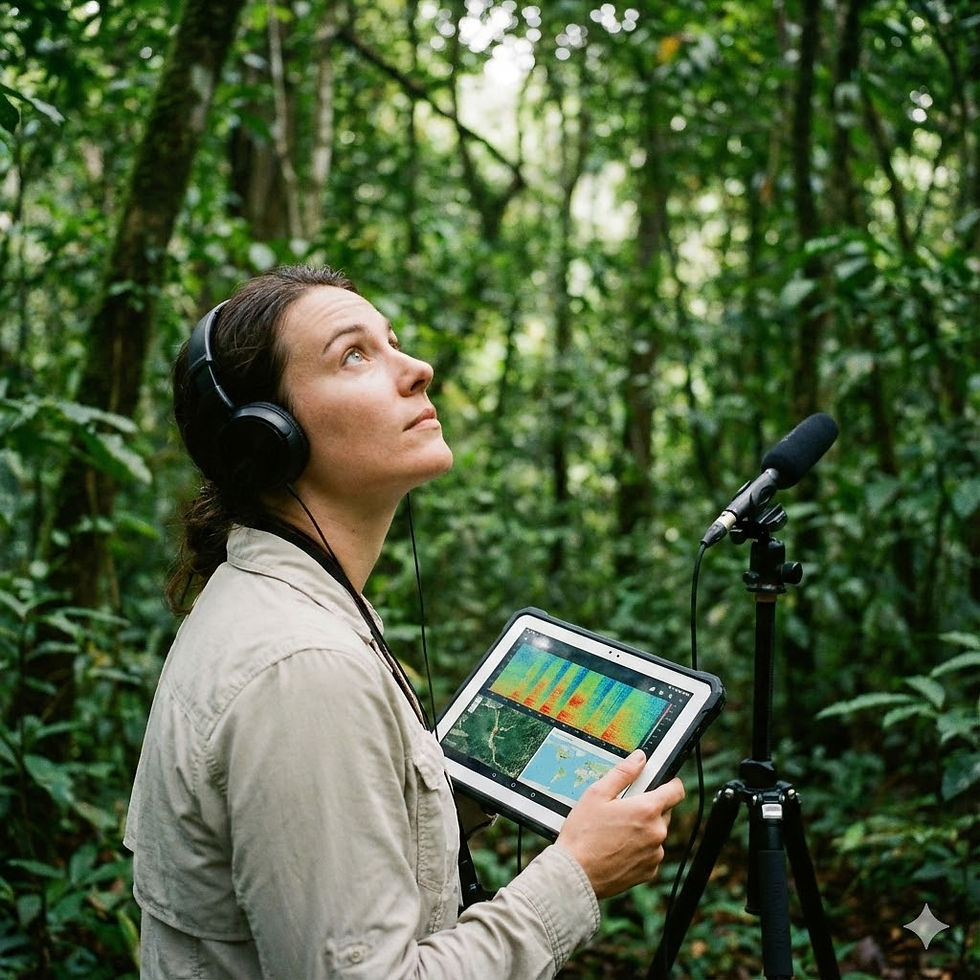
2020s — Bioacoustics AI: Machine learning models begin mathematically identifying individual species by their acoustic calls, realizing that "quiet" forests are structurally dying forests.
2026 — The Digital Twin of Earth: Platforms like NVIDIA's Earth-2 provide a live, AI-powered digital simulation of the entire planet's climate and biosphere, allowing us to computationally test massive interventions before deploying them in physical reality.
2050 (Prediction) — The Great Rewilding: AI-managed, automated robotic systems have successfully helped restore 30% of severely degraded land, creating vast, interconnected wildlife corridors natively integrated with human cities.
🔑 Key Takeaways:
Human history shifted from fearing nature, to exploiting it, to desperately trying to save it.
The Industrial Revolution accelerated ecosystem collapse by treating finite resources as infinite.
The current AI era treats the Earth as a complex, mathematical system that can be modeled and healed.
🗣️ 2. Decoding Gaia: The Universal Translator
For centuries, biological humans looked at nature and saw only silence. We arrogantly assumed animals, plants, and fungi were simply mute, unfeeling automatons. We were completely wrong. We just didn't speak their biological frequency.
The Shift: Bioacoustic Monitoring.
The Universal Translator: A biological human can easily hear a single bird singing. An AI algorithm can mathematically hear 10,000 birds singing simultaneously, instantly identify every single distinct species, mathematically detect stress patterns in their specific calls, and accurately map the biological health of the entire ecosystem based entirely on the mathematical density of the "soundscape."
The Insight: AI is actively revealing that nature is a vibrant, incredibly noisy biological conversation. By flawlessly translating the clicks of deep-sea whales, the low-frequency rumble of migrating elephants, and even the electrical, subterranean signals of fungi networks (the "Wood Wide Web"), AI is finally giving nature a measurable, numerical voice in our geopolitical decision-making processes. We are moving from managing mute resources to actively communicating with our planetary neighbors.
🔑 Key Takeaways:
Bioacoustics uses AI to monitor ecosystem health by analyzing the density and variety of animal calls.
Nature is highly communicative; we previously just lacked the mathematical tools to "listen."
AI acts as a translator, turning biological soundscapes into actionable conservation metrics.

🛰️ 3. The Planetary Nervous System
You absolutely cannot fix what you cannot physically see. For most of human history, massive ecological destruction happened entirely too slowly or too remotely for humans to notice until it was far too late.
The Shift: Real-Time Ubiquitous Sensing. We are actively wrapping the physical planet in an invisible digital web of sensors—from high-resolution, AI-equipped satellites peering from low-earth orbit, to autonomous DNA sequencers floating in remote rivers detecting the shedding of elusive, endangered species.
The "Macroscope": Optical satellites, heavily combined with advanced computer vision algorithms, can now spot illegal, microscopic logging operations deep in the Amazon rainforest in real-time. The AI mathematically counts the individual fallen trees and instantly alerts local authorities before the diesel trucks even leave the jungle.
The Insight: Artificial Intelligence is aggressively becoming the physical planet's central nervous system. It mathematically feels the pain of illegal deforestation or toxic ocean pollution instantly, seamlessly converting vague, delayed environmental anxiety into highly actionable, real-time data.
🔑 Key Takeaways:
Ubiquitous sensing provides a real-time, high-definition dashboard of the Earth's biological health.
Computer vision on satellites detects and halts illegal deforestation as it physically happens.
AI converts slow, invisible ecological collapse into immediate, actionable alerts.
🤖 4. The Robots of Restoration: Scaling the Cure
Humanity has ruthlessly destroyed complex ecosystems at a massive, industrial scale. Hand-planting individual trees or manually cleaning toxic oceans is statistically, tragically too slow. We desperately need algorithmic restoration at the exact same speed as our industrial destruction.
The New Workforce: If the diesel bulldozer was the destructive icon of the 20th century, the autonomous restoration drone is the healing icon of the 21st.
Aerial Reforestation: Massive, coordinated drone swarms can autonomously fire nutrient-rich, bio-engineered seed pods deep into degraded, burned land, perfectly planting tens of thousands of trees a day in dangerous, mountainous areas biological humans simply cannot safely reach.
Coralbots: Autonomous underwater robotics (AUVs) are aggressively outplanting heat-resistant, genetically fortified coral larvae directly onto dying, bleached reefs, working tirelessly 24/7 in the crushing depths to rebuild foundational marine habitats.
Precision Agriculture: AI-driven, computer-vision farm machinery mathematically sprays micro-doses of pesticides only on the specific, identified weed, instantly reducing toxic chemical soil runoff by an incredible 90%.
The Insight: We are no longer just trying to save nature; we are actively, robotically automating the healing process.
🔑 Key Takeaways:
Human manual labor is mathematically too slow to reverse industrial-scale ecological damage.
Drone swarms and underwater robots automate replanting and reef restoration 24/7.
Precision agriculture uses AI vision to drastically eliminate toxic chemical runoff.

🛡️ 5. The Humanity Script: The Ethics of Stewardship
We are rapidly gaining terrifying, god-like computational powers over the biosphere. But history proves we are exceptionally terrible at playing God. How do we responsibly use this power without succumbing to fatal algorithmic hubris?
The Humanity Script:
Rule 1: Humility over Engineering. An unaligned AI model might aggressively suggest optimizing a forest for "maximum carbon capture" by mathematically planting only one specific type of fast-growing, genetically modified tree. We must violently resist this. A sterile monoculture is not a biological forest. We must legally force AI to support incredibly complex, messy biodiversity, not just optimize for singular, highly profitable corporate metrics.
Rule 2: The "Wildness" Mandate. The ultimate goal is absolutely not to turn the Earth into a perfectly managed, sterile AI garden. We must use technology strictly to determine which biological areas desperately need less human intervention. Sometimes the absolute best, most profound thing an AI can tell us is: "Leave this place completely alone."
Rule 3: Indigenous Integration. Modern AI is built entirely on massive data. But global indigenous communities hold thousands of years of invaluable, highly localized "deep data" on their specific ecosystems. The "Humanity Script" vehemently demands that algorithmic AI restoration models are trained on, and strictly validated by, local, ancestral ecological knowledge, not just cold satellite imagery from Silicon Valley.
🔑 Key Takeaways:
We must prioritize messy, organic biodiversity over highly optimized, sterile monocultures.
AI should identify areas to be aggressively protected from all human and robotic intervention.
Ancestral indigenous knowledge must be integrated into algorithmic ecological models.
✨ 6. The Humanity-Saving Scenario: The Biosphere Integration Mandate
If we allow massive tech corporations to unilaterally deploy geoengineering drones and biological AI models without strict ethical constraints, we will replace organic ecosystems with highly profitable, patented, synthetic monocultures. When a corporation algorithmically decides that a diverse, ancient forest is "inefficient" at capturing carbon and replaces it with a sterile, genetically modified tree farm, we have not saved nature; we have murdered it and replaced it with a machine. To prevent the corporate takeover of the Earth's biosphere, we must actively architect the Humanity-Saving Scenario.
This scenario dictates the international legislative ratification of the Biosphere Integration and Stewardship Mandate. This sweeping ecological framework legally outlaws "Algorithmic Monocultures"—making it a severe federal crime for any AI-driven restoration project to optimize for a single metric (like carbon capture) at the expense of native biodiversity.
The Mandate legally requires that all AI restoration models operate with an "Indigenous Oversight Loop," ensuring that local, ancestral ecological knowledge legally overrides pure algorithmic efficiency. Furthermore, the Humanity-Saving Scenario establishes heavily defended "Wildness Zones"—massive tracts of the planet legally protected from any technological intervention, where AI is used exclusively to keep humans out, allowing organic biology to heal itself on its own timeline. By legally binding AI to the laws of complex biology, we ensure our technology heals the planet instead of sterilizing it.
🗣️ Over to You: The Symbiotic Future
We began shivering in the cave, deeply fearful of the dark, violent wilderness. We violently traveled through the industrial age, burning that very wilderness to the ground just to light our cities. Now, we stand at the terrifying threshold of an entirely new era. The "hearth" we must desperately protect is no longer just the fire in our living room; it is the entire biosphere itself—the incredibly thin, fragile green and blue envelope that keeps the cold, lethal vacuum of space at bay.
AI perfectly gives us the eyes to see the global damage, the ears to understand the silent victims, and the robotic hands to scale the repairs. But it does absolutely not give us the wisdom to know when to stop. "The Great Restoration" is not just about fixing the math of the carbon cycle; it’s about fixing our human mindset. It is the realization that in the complex network of biological life, there are absolutely no independent nodes. We either thrive together, or we completely collapse alone. Technology is the lifeline, but humanity must be the anchor.
The Trust Test: Would you completely trust an autonomous AI to dynamically manage a massive national park's ecosystem, perhaps independently deciding to mathematically cull one species just to save another, entirely without human sign-off?
The Nostalgia: Do you deeply worry that by mediating nature entirely through glowing screens, drones, and data dashboards, we permanently lose the raw, visceral, biological connection to the wild?
The Priority: Should global investment focus significantly more on high-tech, robotic restoration (drone planting) or high-tech, defensive conservation (anti-poaching AI networks)?
Outline your perspective on implementing the Humanity-Saving Scenario to establish the Biosphere Integration Mandate. We invite you to share your vital thoughts and join this critical battle for our planet in the comments below! 👇
📖 Glossary of Key Terms
Bioacoustics: 🧬 The scientific use of deployed sound recorders and AI pattern analysis to flawlessly monitor biodiversity and ecosystem health by mathematically listening to animal vocalizations.
Digital Twin of Earth: 🌍 A highly complex, dynamic virtual supercomputer model of the planet's entire physical and biological systems, used to simulate global climate scenarios and safely test ecological interventions.
Remote Sensing: 🛰️ The scanning of the earth by high-resolution satellites or high-flying autonomous aircraft in order to obtain real-time, actionable data about deforestation and emissions.
Keystone Species: 🦋 A highly critical biological species on which other species in an ecosystem largely depend; if it were removed, the ecosystem would violently, mathematically collapse.
Rewilding: 🌿 Radical conservation efforts aimed at actively restoring and protecting organic natural processes and wilderness areas, often by reintroducing apex predators or completely stepping back from managed land.

Posts on the topic 🧬 Evolution: From Stone to Code:
From the Cave Fire to the Neural Network: The Grand Timeline of Comfort
From Clay Tablets to Neuro-Tutors: The Awakening of Human Potential
From Shamanic Rituals to Rewriting DNA: How We Learned to Cheat Death
From the Clay Ledger to the Blockchain Oracle: The Evolution of Value
From the Silk Road to Teleporting Matter: Victory Over Distance
From the Hammer Strike to the Digital Twin: Forging the Future
From the Grand Bazaar to Predicting Desires: The Evolution of Trade
From Rain Prayers to Planetary Gardening: The Great Battle for Bread
From Campfire Tales to Infinite Dreams: The New Era of Storytelling
From Stone Walls to the Iron Dome: The Shield of Civilization
From Prometheus' Fire to the Artificial Sun: The Chase for Infinite Energy
From the Code of Hammurabi to Algorithmic Justice: The Search for Absolute Truth
From Scribe Scrolls to the Sentient City: Governance 2.0
From Alchemy to Digital Simulation: Accelerating Cognition
From Stargazing to the Ark of Humanity: The Expansion of Reason
From Smoke Signals to Digital Telepathy: Weaving the Global Web
From Conquering Nature to Harmony with It: The Great Restoration of Earth
From Cloud Divination to Taming the Storm: The Prediction Revolution
From Mud Huts to Living Organisms: The Birth of the Conscious City
From the Town Crier to the Soul Reader: The Art of Connection
From Animal Skins to Digital Couture: The Fabric of Identity
From the Pyramids of Giza to Self-Assembling Buildings: The Architecture of a New World
From Cave Paintings to the Infinite Canvas: The Democratization of Creativity
From Dice to Living Simulations: Engineering Realities
From the Tower of Babel to Universal Understanding: Shattering the Walls of Silence
From Tribal Instincts to the Global Hive: Deciphering the Human Code
From Pilgrims to Experience Curators: The Art of Discovery
From the Assembly Line to Talent Architecture: Liberating the Creator
Explore AI fundamentals and their true impact on the world


Comments