
From the Pyramids of Giza to Self-Assembling Buildings: The Architecture of a New World
Updated: 4 days ago

🏗️ Aiwa-AI Perspective: Architecture of Growth Over Destruction
Construction is the most visible, physical footprint of humanity. For 5,000 years, it was an act of brute force—violently fighting gravity with muscle, and fighting nature with concrete and steel.
At Aiwa-AI, we believe that Artificial Intelligence is actively shifting the architectural paradigm from 'Construction' to 'Growth.' By leveraging generative design and massive additive manufacturing, we are officially entering an era where buildings are not just rigidly erected, but organically optimized like biological organisms—using the absolute minimum amount of material to achieve the maximum amount of physical strength and aesthetic beauty.
Construction that creates rather than destroys.
In this post, we explore:
1. 📜 The Grand Timeline: From the Ramp to the Drone Swarm.
2. 🎨 The Architect’s Dream: Generative Design and Biomimicry.
3. 🖨️ The House That Prints Itself: Solving the Housing Crisis.
4. 🤖 The Dangerous Job: Robots on the Front Lines.
5. 🛡️ The Humanity Script: Shelter vs. Home.
6. ✨ The Humanity-Saving Scenario: The Regenerative Architecture Act.
📜 1. The Grand Timeline: The Weight of the World
The entire history of human construction is simply the history of material science: Stone -> Brick -> Concrete -> Steel -> Code.
🏛 Era I: The Age of Mass (Stone & Brick - ~2560 B.C.–1100s A.D.)
The Paradigm: We build exclusively by piling incredibly heavy things on top of each other.
~2560 B.C. — The Great Pyramid: The absolute pinnacle of "Mass Construction." It relies entirely on gravity and brutal precision cutting.
~100 A.D. — Roman Concrete: The Turning Point. The Romans invent opus caementicium. They can pour liquid stone into wooden molds. This miraculously allows for vast arches, unsupported domes (the Pantheon), and rapid imperial infrastructure.
1100s — The Gothic Cathedral: We learn to mathematically distribute weight outward (flying buttresses), allowing towering walls to become fragile glass. Light finally enters the building.
⚙️ Era II: The Age of Steel (The Skeleton - 1800s-1900s)
The Paradigm: We physically separate the skin of the building from the bones.
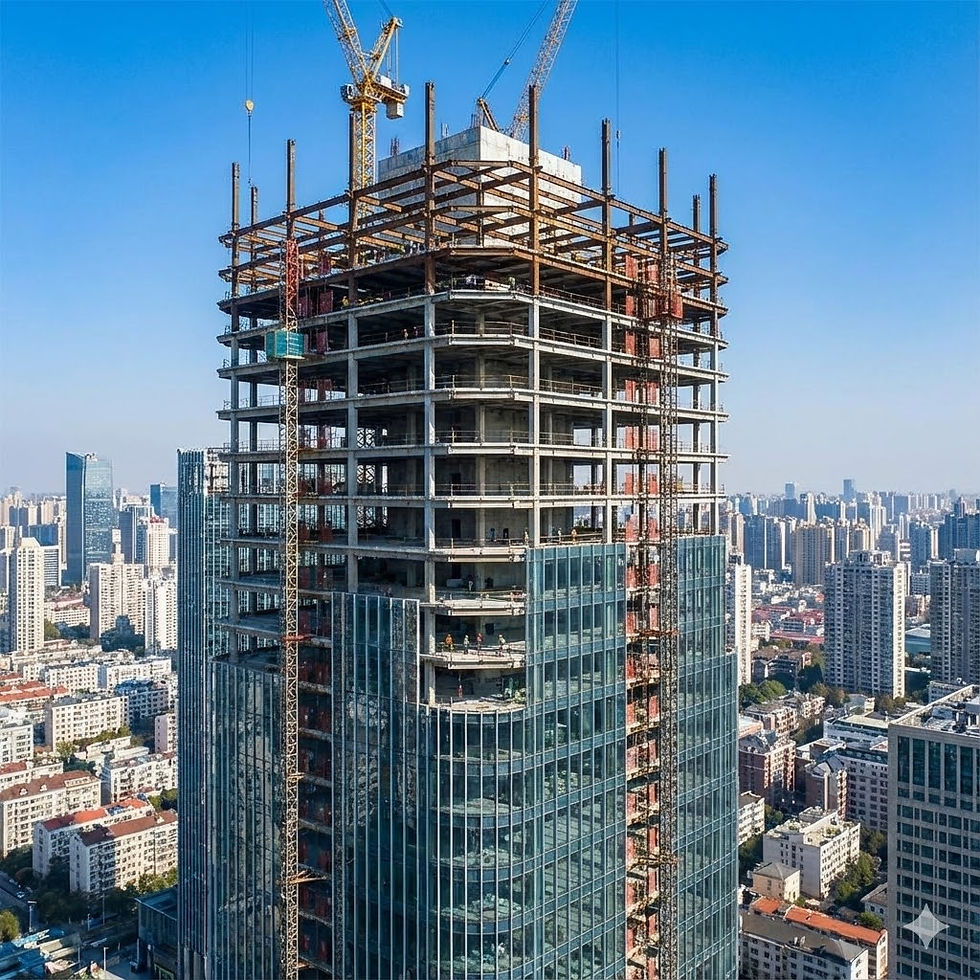
1852 — The Safety Elevator (Otis): This single invention makes high-rise buildings practical. Without it, physical skyscrapers are completely useless.
1885 — The Skyscraper (Home Insurance Building): We permanently stop using exterior walls to hold up the heavy roof. We use a hidden steel frame. Buildings can now go vastly higher than 10 stories. The modern skyline is violently born.
💻 Era III: The Age of the Model (Digitization - 1960s-2000s)
The Paradigm: We stop drawing on physical paper and start simulating in 3D.
1963 — Sketchpad: The grandfather of CAD (Computer-Aided Design). Architects actively begin to draw with digital light.
2000s — BIM (Building Information Modeling): The building is no longer just lines on a screen; it is a massive database. A digital wall in the model mathematically "knows" it is a wall, and knows its exact cost, physical weight, and thermal properties.
🤖 Era IV: The Age of Fabrication (AI & Robotics - 2010s-2030s)
The Paradigm: The digital model physically, autonomously builds the reality.
2018 — Generative Design: AI designs a structural partition wall for Airbus that is 45% lighter than a human design, using highly organic, "bionic" shapes.
2021-2024 — 3D Printed Neighborhoods: ICON successfully prints the massive 100-home Genesis Collection at Wolf Ranch in Texas using robotic Vulcan printers. Construction officially becomes a scalable software problem.
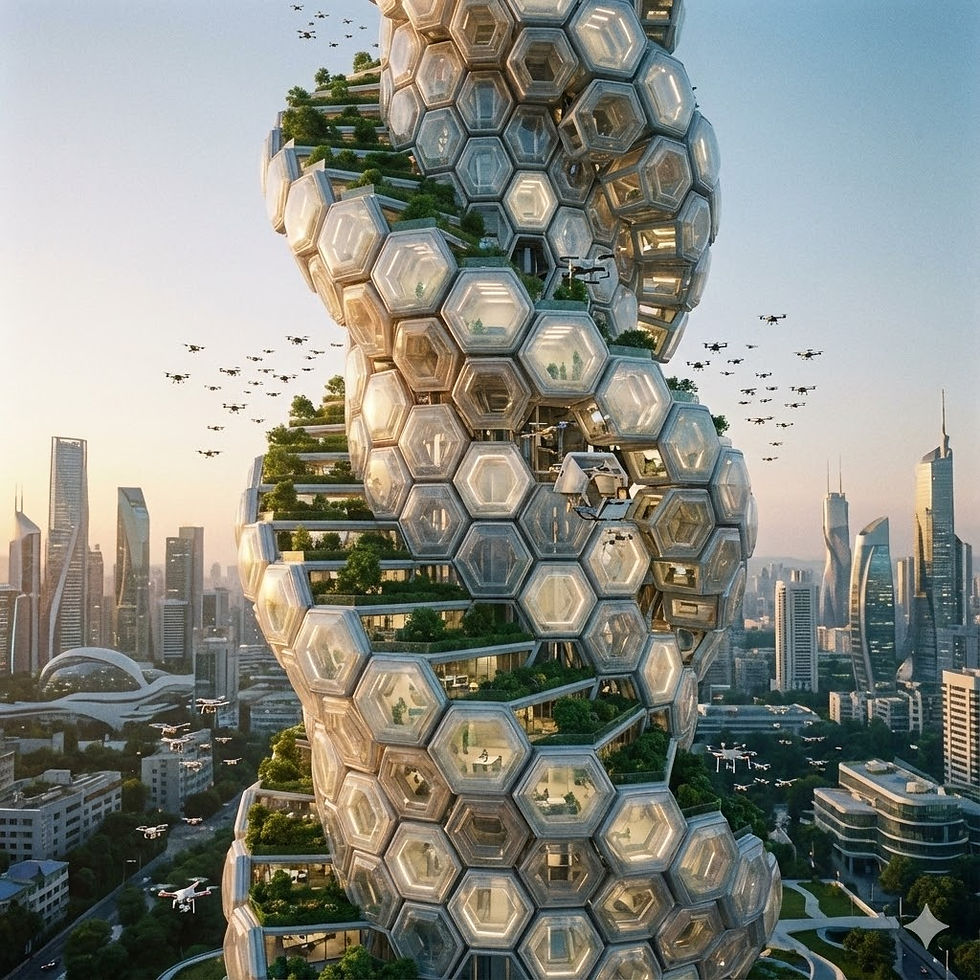
2030 (Prediction) — Swarm Construction: Thousands of small, autonomous aerial drones work together perfectly like biological termites to physically print a skyscraper, repairing micro-fractures continuously as it ages.
🔑 Key Takeaways:
Construction history is driven by reducing the weight of materials while increasing structural integrity.
The invention of the steel frame separated structural support from the exterior facade.
AI and robotics transition architecture from manual assembly to autonomous, digital fabrication.
🎨 2. The Architect’s Dream (Generative Design)
For 4,000 years, a biological architect drew a rigid line, and the biological builder built it. If the architect made a mathematical mistake, the building catastrophically fell down.
The Shift: You no longer draw the building; you exclusively define the mathematical constraints.
The Prompt: An architect tells the AI: "I need a school for 500 children, physically located on this exact topographical plot of land, maximizing natural sunlight, minimizing heating cost, and structurally guaranteed to survive a 8.0 magnitude earthquake."
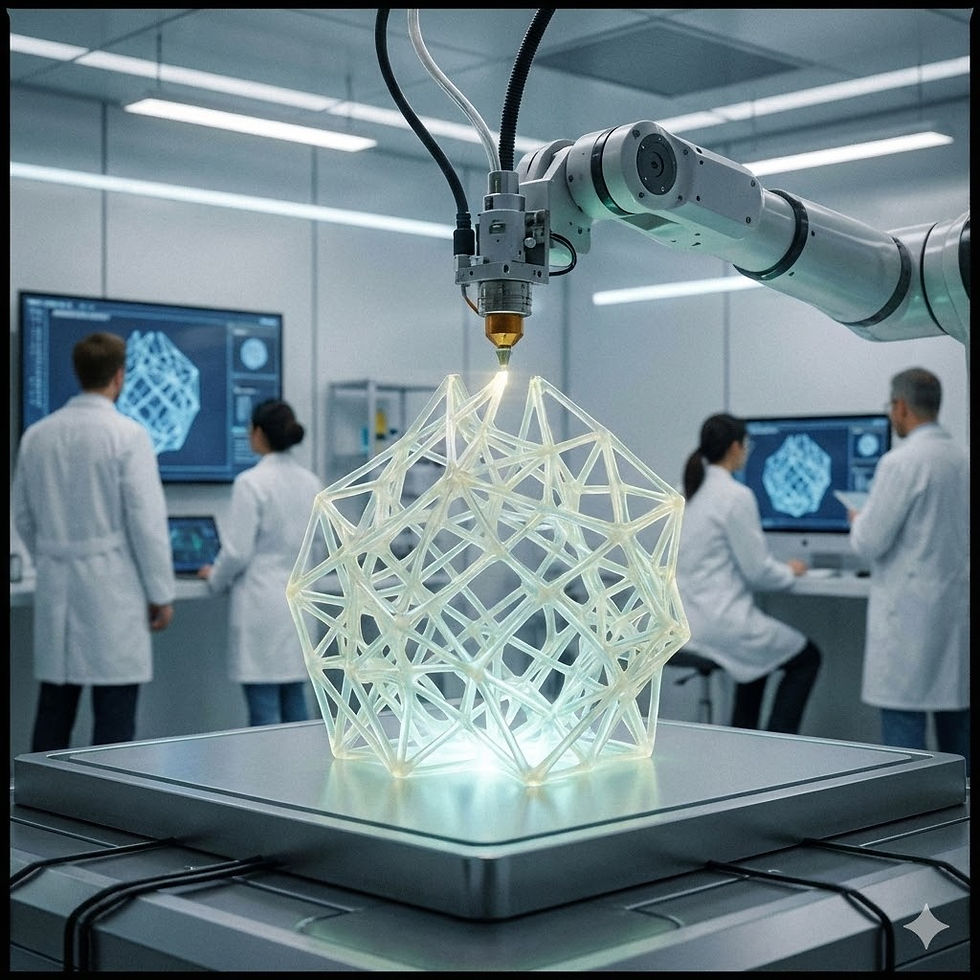
The Result: The AI runs 10,000 physics simulations in a matter of hours. It mathematically generates options no human would ever intuitively think of—highly organic, bone-like lattice structures that aggressively use 30% less steel but are mathematically twice as strong.
Biomimicry: Modern generative design programs increasingly use a biomimetic approach, algorithmically "growing" structural features that perfectly distribute loads, much like watching algae or bone tissue grow under a microscope. This is the flawless marriage of computational physics and organic biology.
🔑 Key Takeaways:
Generative design shifts the architect's role from manual drafting to defining systemic constraints.
Biomimicry allows AI to "grow" structures optimizing for material efficiency and immense strength.
AI can run thousands of load-bearing physics simulations in the time it takes a human to draw one blueprint.
🖨️ 3. The House That Prints Itself
Traditional construction is incredibly, unforgivably wasteful. We blindly cut expensive wood and throw away the physical scraps. We pour toxic concrete and toss the wooden forms. Nearly 30% of all global physical waste comes exclusively from the construction industry.
The Shift: Additive Manufacturing (3D Construction Printing).
Precision Pouring: A robotic 3D printer only extrudes physical material exactly where the 3D software dictates it is needed. There are absolutely no scraps. There is zero physical waste. Geometry becomes effectively free—a beautiful curved wall costs the exact same amount to print as a boring straight one.
Speed & Affordability: A robotic gantry printer does not biologically sleep. It does not take lunch breaks. It can perfectly print the resilient, hurricane-proof shell of a house in just days, significantly slashing labor overhead. This software-driven scalability is the absolute key to finally solving the global, politically charged housing crisis.
🔑 Key Takeaways:
3D Construction Printing (3DCP) eliminates the massive physical waste of traditional subtractive building.
Additive manufacturing makes complex, curved, organic geometry highly affordable.
Robotic printing slashes construction timelines, offering a viable solution to housing shortages.
🤖 4. The Dangerous Job
Construction remains one of the deadliest physical industries on the planet. High falls, structural collapses, and heavy equipment accidents violently kill thousands of human beings every single year.
The Shift: The Robot Worker.
The Bricklayer: Autonomous, truck-mounted robots (like the Hadrian X) can mathematically lay 1,000 bricks an hour with flawless, millimeter laser precision. The biological human simply manages the software and monitors the physical material supply.
The Scanner: A four-legged robotic dog (like Boston Dynamics' Spot) autonomously walks through the pitch-black construction site at night, aggressively scanning the day's physical progress with LiDAR lasers to ensure the actual building perfectly matches the digital BIM model down to the millimeter.
Safety: By actively letting disposable robots handle the terrifying heights and the bone-crushing heavy lifting, we save fragile human bodies strictly for the highly skilled, creative finishing work.
🔑 Key Takeaways:
Robotics drastically reduces biological human fatalities in the construction industry.
Autonomous laser scanning ensures physical buildings perfectly match their digital twins.
Machines execute the brute force labor, elevating humans to supervisory and finishing roles.
🛡️ 5. The Humanity Script: The Soul of the Place
We can effortlessly print a physical house, but can a machine print a home?
The Risk: Soulless Uniformity. If we blindly let algorithms financially optimize and perfectly design our cities, we risk engineering highly efficient but completely sterile physical environments—"Communist Blocks 2.0," but with flawless algorithmic curves.
The Humanity Script:
Imperfect Beauty: We must fiercely value biological texture, the human mistake, and the organic craft. A hand-carved, wooden door possesses a profound cultural and emotional value that a flawless, 3D-printed polymer door never physically will.
Context: An AI can flawlessly design a building that obeys the laws of physics, but a biological human architect must ensure it actually fits the organic culture, the local community, and the deep history of the surrounding neighborhood.
Adaptive Reuse: The absolute most sustainable, eco-friendly building on Earth is the one that already exists. AI should be aggressively deployed to help us intelligently retrofit and restore beautiful old buildings, rather than mindlessly knocking them down to print sterile new ones.
🔑 Key Takeaways:
Perfect algorithmic efficiency must not erase organic cultural texture and human craftsmanship.
AI cannot understand local community context or the emotional weight of a neighborhood.
Adaptive reuse of existing architecture is vastly more sustainable than printing new structures.
✨ 6. The Humanity-Saving Scenario: The Regenerative Architecture & Housing Sovereignty Act
If we allow a few massive tech and construction conglomerates to patent all the 3D architectural files and monopolize the robotic printing fleets, they will hold the ultimate monopoly on human shelter. They could enforce proprietary, subscription-based housing grids that entirely strip local communities of architectural autonomy. To ensure that additive manufacturing democratizes shelter rather than corporatizing it, we must actively architect the Humanity-Saving Scenario.
This scenario dictates the legislative ratification of the Regenerative Architecture and Housing Sovereignty Act. This sweeping framework legally requires that all foundational, AI-generated residential building blueprints be classified as "Open Source Civic Assets," making the structural code for basic, safe housing freely available to any community on Earth.
The Act explicitly outlaws "Algorithmic Gentrification"—mandating that any AI-designed urban development plan must include a legally binding "Human-in-the-Loop Cultural Audit" by local citizens before a single robot is deployed to the site. Furthermore, the Humanity-Saving Scenario heavily incentivizes Adaptive Reuse by aggressively taxing the demolition of existing structures, forcing AI to prioritize retrofitting over destruction. By legally decoupling the software of shelter from corporate monopolies, we guarantee that the cities of the future are built to house human souls, not just to generate corporate profit.
🗣️ Over to You: The Architecture of a New World
We are aggressively moving from the Pyramid, a brutal monument to death built by human suffering, to the Living Building, a highly optimized shelter for life built by synthetic intelligence. The goal is not just to build a world that is a collection of sterile printed boxes, but a physical landscape that actively heals the biological people who live in it.
The Design: Would you personally feel comfortable living in a house with "organic, bone-like" walls if it was 50% cheaper and mathematically twice as strong, or do you biologically prefer traditional straight lines?
The Workforce: If automated robots successfully lay bricks and effortlessly pour concrete 24/7, what exactly happens to the millions of biological human construction workers who rely on that labor?
The Future: If you could personally 3D print your own completely customized house tomorrow for $10,000, what crazy, physically impossible shape would you design?
Outline your perspective on implementing the Humanity-Saving Scenario to establish the Regenerative Architecture Act. We invite you to share your visionary thoughts and join this critical battle for our physical environment in the comments below! 👇
📖 Glossary of Key Terms
Generative Design: 🎨 An iterative, algorithmic design process that uses massive computing power to generate thousands of structural outputs that perfectly meet specific mathematical and physical constraints.
BIM (Building Information Modeling): 🏗️ A complex software process involving the generation and management of flawless digital representations of physical and functional characteristics of places.
3DCP (3D Construction Printing): 🖨️ The revolutionary technology of using massive, robotic 3D printers to extrude concrete or polymers to fabricate entire buildings layer by layer.
Biomimicry: 🦴 The architectural design and production of materials, structures, and systems that are mathematically modeled on organic biological entities (like bones or termite mounds).
Prefabrication: 🧬 The highly efficient practice of assembling components of a structure in a controlled factory environment, and transporting the completed assemblies to the physical construction site.

Posts on the topic 🧬 Evolution: From Stone to Code:
From the Cave Fire to the Neural Network: The Grand Timeline of Comfort
From Clay Tablets to Neuro-Tutors: The Awakening of Human Potential
From Shamanic Rituals to Rewriting DNA: How We Learned to Cheat Death
From the Clay Ledger to the Blockchain Oracle: The Evolution of Value
From the Silk Road to Teleporting Matter: Victory Over Distance
From the Hammer Strike to the Digital Twin: Forging the Future
From the Grand Bazaar to Predicting Desires: The Evolution of Trade
From Rain Prayers to Planetary Gardening: The Great Battle for Bread
From Campfire Tales to Infinite Dreams: The New Era of Storytelling
From Stone Walls to the Iron Dome: The Shield of Civilization
From Prometheus' Fire to the Artificial Sun: The Chase for Infinite Energy
From the Code of Hammurabi to Algorithmic Justice: The Search for Absolute Truth
From Scribe Scrolls to the Sentient City: Governance 2.0
From Alchemy to Digital Simulation: Accelerating Cognition
From Stargazing to the Ark of Humanity: The Expansion of Reason
From Smoke Signals to Digital Telepathy: Weaving the Global Web
From Conquering Nature to Harmony with It: The Great Restoration of Earth
From Cloud Divination to Taming the Storm: The Prediction Revolution
From Mud Huts to Living Organisms: The Birth of the Conscious City
From the Town Crier to the Soul Reader: The Art of Connection
From Animal Skins to Digital Couture: The Fabric of Identity
From the Pyramids of Giza to Self-Assembling Buildings: The Architecture of a New World
From Cave Paintings to the Infinite Canvas: The Democratization of Creativity
From Dice to Living Simulations: Engineering Realities
From the Tower of Babel to Universal Understanding: Shattering the Walls of Silence
From Tribal Instincts to the Global Hive: Deciphering the Human Code
From Pilgrims to Experience Curators: The Art of Discovery
From the Assembly Line to Talent Architecture: Liberating the Creator
Explore AI fundamentals and their true impact on the world


Comments