
From Tribal Instincts to the Global Hive: Deciphering the Human Code
Updated: 6 days ago

👨👩👧👦 Aiwa-AI Perspective: The Macroscope of Humanity
For centuries, we tried to understand the vast, chaotic complexity of human society by looking through the narrow keyhole of small surveys, anecdotal observations, and pure intuition.
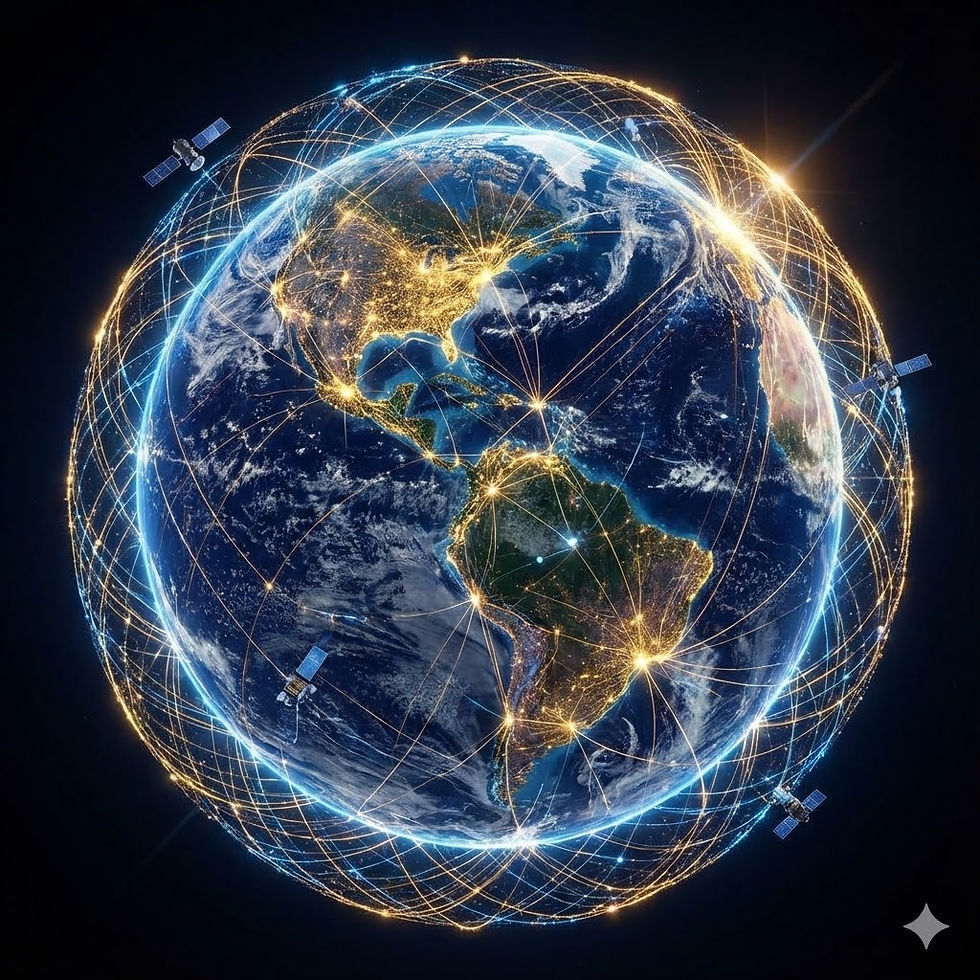
At Aiwa-AI, we believe that Big Data has finally given us a true 'Macroscope'—a staggering technological lens that allows us to physically see the collective mind of the Global Hive in real-time. We are no longer just guessing why we act; we are mathematically decoding the algorithm of human connection itself.
However, the true, existential power of this science lies not in predicting behavior to profitably manipulate it, but in understanding our shared biological nature well enough to architect a world where we can all organically thrive.
In this post, we explore:
1. 📜 The Grand Timeline: From the Domesday Book to Psychographics.
2. 🤥 The Death of the Survey: Why "Big Data" Tells the Truth When People Lie.
3. 🔬 The Macroscope: Seeing the Invisible Patterns of Culture.
4. 🔮 Predicting the Unpredictable: Forecasting Revolutions and Crashes.
5. 🛡️ The Humanity Script: Engineering vs. Freedom.
6. ✨ The Humanity-Saving Scenario: The Cognitive Liberty Act.
📜 1. The Grand Timeline: Measuring the Hive
We started by counting physical heads. Now we mathematically map human minds.
🏛 Era I: The Age of the Census (Counting Bodies - 1000s-1800s)
The Paradigm: The sovereign State desperately needs to know who to tax and who to violently draft for war.
1086 — The Domesday Book: William the Conqueror brutally catalogs all of England. It’s a static, physical snapshot. It tells the King who is physically there, but absolutely not what they are thinking.
1897 — Suicide (Émile Durkheim): The absolute birth of Sociology. Durkheim brilliantly uses data to scientifically prove that suicide is not just an isolated personal tragedy, but a measurable "social fact" driven by hidden, macroscopic societal forces.
⚙️ Era II: The Age of Polling (Asking Questions - 1930s-1960s)
The Paradigm: We try to get inside people's heads by politely asking them.
1935 — The Gallup Poll: George Gallup successfully invents scientific polling. He realizes you don't mathematically need to ask everyone; you just need a perfectly representative sample. Democracy finally gets a statistical feedback loop.
1960s — The Milgram Experiments: Psychology violently moves into the controlled lab. We aggressively study authority and obedience to understand the horrors of the 20th century. But these remain small, highly artificial environments.
💻 Era III: The Age of Digital Footprints (Observing Behavior - 2000s-2010s)
The Paradigm: People migrate their entire lives online. Every single digital click becomes a permanent data point.
2004 — Facebook Launches: The single greatest, most intrusive social laboratory in human history opens. For the very first time, we can mathematically map the intimate connections of billions of people.
2010 — Culturomics (Google Ngram): Researchers algorithmically scan 5 million digitized books to mathematically see exactly how human language evolves. We can measure the precise rise and fall of fame, state censorship, and philosophical ideas over centuries.
🤖 Era IV: The Age of Social Physics (The Future - 2020s-2030s)
The Paradigm: We flawlessly predict and "tune" social dynamics using AI.
2016 — Cambridge Analytica: The terrifying warning shot. Rogue data scientists weaponize "Psychographics" (personality profiling illegally derived from Facebook 'likes') to micro-target vulnerable voters. We permanently realize Social Science can be a weapon of mass manipulation.
2030 (Prediction) — Real-Time Sociology: We no longer passively wait for history to happen. We see physical social rifts forming on the digital dashboard of a "Global Sentiment Monitor" weeks before the first physical stone is ever thrown.
🔑 Key Takeaways:
The measurement of society has evolved from counting physical bodies to mapping psychological states.
Digital platforms are the largest, most pervasive behavioral laboratories in human history.
The Cambridge Analytica scandal proved that predicting behavior seamlessly transitions into manipulating it.

🤥 2. The Death of the Survey
"Everybody lies." If a human pollster asks you on the phone: "Do you actively go to the gym?", 70% of people will confidently say yes. If a data scientist secretly looks at their aggregate smartphone GPS data, only 10% actually physically step inside a gym.
The Shift: AI allows researchers to completely bypass the "Social Desirability Bias" (the innate biological desire to look good to your peers).
Search Data: You might confidently tell a pollster you hold no prejudices, but your anonymous, late-night Google searches mathematically reveal an entirely different, much darker truth.
Behavioral Reality: Social Science is aggressively moving from analyzing what people say to analyzing what people actually do. This is a brutal, deeply uncomfortable, but absolutely necessary upgrade for scientific truth.
The core insight is chilling: Anonymous data is the new global confessional.
🔑 Key Takeaways:
Human beings systematically lie in surveys due to "Social Desirability Bias."
Anonymous digital behavior (search history, GPS) provides a vastly more accurate picture of reality.
Computational Social Science prioritizes verified actions over stated intentions.
🔬 3. The Macroscope
In biology, the physical microscope finally let us see invisible cells. In astronomy, the optical telescope let us see distant stars. Big Data is the ultimate Macroscope for human society.
Mapping Bias: AI brutally analyzes millions of corporate job descriptions and mathematically proves that specific, seemingly innocuous words completely discourage women from applying. We can physically see the hidden, encoded structures of systemic inequality.
The Pulse of the City: Aggregated mobile phone data flawlessly shows how a modern city "breathes"—exactly where people move, exactly where the rich literally never cross physical paths with the poor (hyper-segregation), and precisely how a cultural festival instantly changes the cardiovascular flow of an entire nation.
🔑 Key Takeaways:
Big Data allows us to visualize macro-societal trends that are invisible to the individual human eye.
Natural Language Processing can mathematically reveal systemic biases hidden in our daily communication.
GPS and cellular data map the physical reality of economic segregation in modern cities.
🔮 4. Predicting the Unpredictable
If we possess the macroscope, can we mathematically predict a physical revolution?
The Arab Spring: Retrospective, algorithmic analysis of Twitter data conclusively showed massive "cascades" of localized anger mathematically building up for weeks before the physical protests ever began. The digital tremors preceded the physical earthquake.
The Limits of Prediction: Biological humans are incredibly complex. AI is spectacular at predicting aggregate behavior (what a massive crowd of 100,000 people will statistically do), but it remains terrible at predicting individual behavior (exactly what you will do tomorrow).
The Danger of the Self-Fulfilling Prophecy: If a predictive policing AI algorithm mathematically forecasts a crime wave in a specific minority neighborhood, police departments will heavily over-police that physical area. This inevitably leads to more arrests for minor infractions, which feeds back into the algorithm, creating a devastating, mathematically guaranteed self-fulfilling prophecy.
🔑 Key Takeaways:
Social media data serves as an early-warning seismograph for real-world political upheaval.
AI is highly accurate at predicting crowds, but highly inaccurate at predicting individuals.
Predictive social algorithms can trap vulnerable communities in algorithmic feedback loops.

🛡️ 5. The Humanity Script: Engineering vs. Freedom
This is the absolute most dangerous frontier of the 21st century. If tech monopolies mathematically understand the underlying code of human behavior, they can effortlessly hack it. This is scientifically known as "Social Physics" or "Algorithmic Nudging."
The Benign Use: A democratic government ethically uses AI to redesign municipal tax forms so 20% more citizens successfully pay on time, completely without physical coercion.
The Dark Use: A massive social media platform utilizes AI to deliberately show you hyper-targeted content that makes you biologically furious, because their data proves that human anger maximizes your screen time and increases their ad revenue.
The Ethical Line: We must violently distinguish between observing society and actively manipulating it. Social Science was structurally meant to be a diagnostic mirror, absolutely never a corporate remote control.
At Aiwa-AI, we fiercely advocate for Cognitive Liberty—the fundamental biological right to make up our own minds without being invisibly, mathematically steered by a hidden corporate algorithm optimizing purely for engagement metrics.
🔑 Key Takeaways:
"Social Physics" and "Nudging" use big data to actively change human behavior.
Corporate algorithms routinely weaponize human anger to maximize profitable engagement.
We must establish "Cognitive Liberty" as a fundamental human right in the algorithmic age.
✨ 6. The Humanity-Saving Scenario: The Cognitive Liberty & Behavioral Governance Act
If we allow the tech industry to perfect the science of "Social Physics" without absolute regulatory oversight, we are guaranteeing a future where free will is a total illusion. When algorithms can perfectly predict our psychological vulnerabilities and micro-target us with bespoke stimuli designed to alter our voting habits, purchasing decisions, and emotional states, biological humans become mere programmable assets. To prevent the weaponization of the Global Hive, we must actively architect the Humanity-Saving Scenario.
This scenario dictates the urgent, international legislative ratification of the Cognitive Liberty and Behavioral Governance Act. This digital human rights framework legally outlaws "Invisible Algorithmic Nudging." The Act makes it a severe federal crime for any tech platform to deploy predictive behavioral models specifically designed to induce anger, fear, or political radicalization for the sake of engagement metrics.
It legally mandates that all social media algorithms must be entirely transparent, allowing independent researchers to audit the specific behavioral vectors the AI is actively optimizing for. Furthermore, the Humanity-Saving Scenario establishes the inalienable human right to "Algorithmic Opt-Out," granting every citizen the legal power to instantly switch their digital feeds from a "Predictive Manipulation Algorithm" to a purely chronological, un-optimized timeline. By legally defending the sanctity of human choice, we ensure the macroscope is used to understand us, not to control us.
🗣️ Over to You: Deciphering the Code
We are finally, mathematically deciphering the human code. We are seeing that we are vastly more predictable than we thought, infinitely more connected than we knew, and terrifyingly more vulnerable than we feared.
The Mirror: If you could magically see a macro-map of your own personal data (everywhere you go, everyone you talk to, everything you search), would you be fascinated or utterly terrified?
The Nudge: Is it ethically acceptable for a democratic government to use AI psychological "nudges" to push you toward healthy behavior (like quitting smoking or paying taxes) without your explicit knowledge?
The Truth: When you take an anonymous survey, do you genuinely tell the absolute truth, or do you subconsciously still try to look "good"?
Outline your perspective on implementing the Humanity-Saving Scenario to establish the Cognitive Liberty Act. We invite you to share your vital thoughts and join this critical defense of human free will in the comments below! 👇
📖 Glossary of Key Terms
Computational Social Science: 🖥️ The academic field that uses massive computational power, AI, and big data to deeply investigate social phenomena and human behavioral dynamics.
Demographics: 📊 The rigid, statistical study of populations (age, race, income). The basic "Hardware" of society.
Psychographics: 🧠 The deeply intrusive study of personality, core values, private opinions, and lifestyles. The exploitable "Software" of the human mind.
Social Physics: 🌌 A quantitative social science that mathematically describes connections between the flow of digital ideas and human behavior, popularized by researchers like Alex Pentland.
Social Network Analysis: 🕸️ Mathematically mapping biological and digital relationships (nodes and edges) to understand exactly how information or political influence flows in a group.
Sentiment Analysis: 🔮 Using Natural Language Processing (NLP) AI to flawlessly determine the hidden emotional tone behind words (positive, negative, angry) on a massive, global scale.
Posts on the topic 🧬 Evolution: From Stone to Code:
From the Cave Fire to the Neural Network: The Grand Timeline of Comfort
From Clay Tablets to Neuro-Tutors: The Awakening of Human Potential
From Shamanic Rituals to Rewriting DNA: How We Learned to Cheat Death
From the Clay Ledger to the Blockchain Oracle: The Evolution of Value
From the Silk Road to Teleporting Matter: Victory Over Distance
From the Hammer Strike to the Digital Twin: Forging the Future
From the Grand Bazaar to Predicting Desires: The Evolution of Trade
From Rain Prayers to Planetary Gardening: The Great Battle for Bread
From Campfire Tales to Infinite Dreams: The New Era of Storytelling
From Stone Walls to the Iron Dome: The Shield of Civilization
From Prometheus' Fire to the Artificial Sun: The Chase for Infinite Energy
From the Code of Hammurabi to Algorithmic Justice: The Search for Absolute Truth
From Scribe Scrolls to the Sentient City: Governance 2.0
From Alchemy to Digital Simulation: Accelerating Cognition
From Stargazing to the Ark of Humanity: The Expansion of Reason
From Smoke Signals to Digital Telepathy: Weaving the Global Web
From Conquering Nature to Harmony with It: The Great Restoration of Earth
From Cloud Divination to Taming the Storm: The Prediction Revolution
From Mud Huts to Living Organisms: The Birth of the Conscious City
From the Town Crier to the Soul Reader: The Art of Connection
From Animal Skins to Digital Couture: The Fabric of Identity
From the Pyramids of Giza to Self-Assembling Buildings: The Architecture of a New World
From Cave Paintings to the Infinite Canvas: The Democratization of Creativity
From Dice to Living Simulations: Engineering Realities
From the Tower of Babel to Universal Understanding: Shattering the Walls of Silence
From Tribal Instincts to the Global Hive: Deciphering the Human Code
From Pilgrims to Experience Curators: The Art of Discovery
From the Assembly Line to Talent Architecture: Liberating the Creator
Explore AI fundamentals and their true impact on the world


Comments