
From the Code of Hammurabi to Algorithmic Justice: The Search for Absolute Truth
Updated: 5 days ago
⚖️ Aiwa-AI Perspective: The Ultimate Blindfold
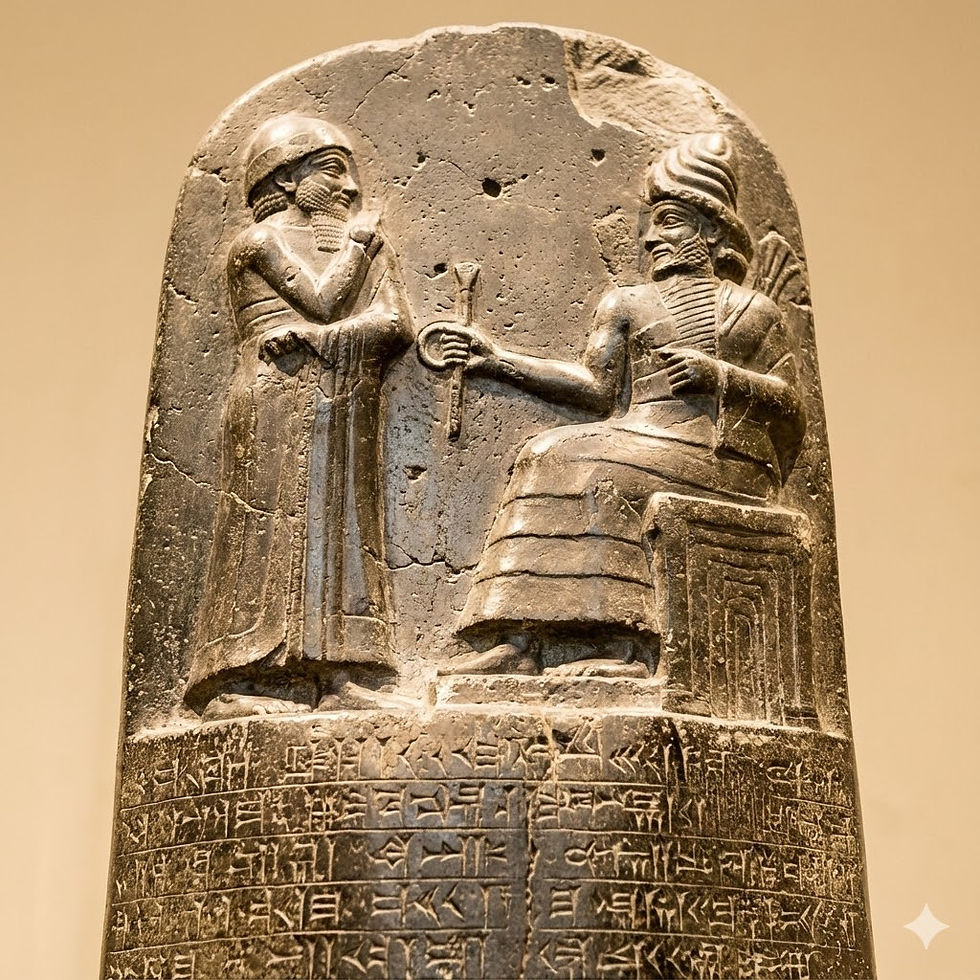
Justice has long been a highly imperfect, biologically flawed reflection of those currently in power—often swift, unnecessarily brutal, and entirely dependent on the physical mood of the King. From the ancient stone pillars of Babylon, human civilization has desperately strived to build a mathematical system where the law applies equally, flawlessly, to all.
At Aiwa-AI, we believe that Artificial Intelligence offers the absolute promise of the ultimate 'Blindfold'—a synthetic justice system that rigorously judges physical actions, absolutely not biological appearances, racial demographics, or the size of a bank account.
However, while algorithmic code can deliver mathematically perfect logic, only a biological human can grant the philosophical grace of mercy. The absolute future of human law lies in aggressively using AI to find the mathematical truth, while strictly keeping the human heart to ethically weigh the physical consequences.
In this post, we explore:
1. 📜 The Grand Timeline: From Stone Tablets to Smart Contracts.
2. ⚖️ The End of Human Bias: Why Machines Might Be Fairer.
3. 🔓 Justice for the 99%: AI Kills the Billable Hour.
4. 🔍 The Speed of Truth: Finding the Needle in e-Discovery.
5. 🛡️ The Humanity Script: The Spirit vs. The Letter of the Law.
6. ✨ The Humanity-Saving Scenario: The Algorithmic Due Process Act.
📜 1. The Grand Timeline: The Architecture of Order
Human law is the literal "Operating System" of biological society. Over thousands of years, we have been desperately, slowly patching the underlying code to remove horrific biological bugs like tyranny, slavery, and systemic corruption.
🏛 Era I: The Age of Retribution (The King's Will - 1754 B.C.–500s A.D.)
The Paradigm: Law is perceived as divine, physically harsh, and mathematically unequal.
1754 B.C. — The Code of Hammurabi: The First Source Code. The King of Babylon forces the laws to be written down on heavy stone specifically so they cannot be changed arbitrarily by corrupt judges. The foundational concept of "written law" is violently born.
450 B.C. — The Twelve Tables (Rome): Roman biological citizens violently force the state to publicly publish the laws. Principle: Ignorantia juris non excusat (Ignorance of the law is absolutely no excuse).
529 A.D. — The Justinian Code: The Byzantine Emperor massively compiles centuries of chaotic Roman law into one coherent, mathematical system. This structure successfully becomes the absolute foundation of all Civil Law in Europe today.
⚙️ Era II: The Age of Rights (The Social Contract - 1200s-1900s)
The Paradigm: We aggressively decide that even divine Kings must biologically obey the mathematical rules.
1215 — Magna Carta: The Absolute Turning Point. English barons physically force King John to legally admit he is not above the law. The foundational concept of "Due Process" is officially born.
1804 — The Napoleonic Code: Napoleon violently exports a highly rational, secular legal system to the conquered world. Laws become mathematically clear, widely accessible, and absolutely not based on ancient, superstitious customs.
1948 — Universal Declaration of Human Rights: After the absolute horrors of WWII, the world desperately agrees on a "Global Constitution." Human rights are legally defined as inherent to being a biological human, absolutely not merely granted by the state.
💻 Era III: The Age of Digitization (The Searchable Law - 1970s-2010s)
The Paradigm: The massive weight of human law physically enters the computer, but the search queries are still driven manually by biological humans.
1973 — LexisNexis: Legal research officially goes digital. Exhausted lawyers finally stop physically digging through dusty, moldy libraries and start typing Boolean searches into glowing databases.
2006 — e-Discovery Rules: The US Federal Courts legally recognize that "evidence" is now almost entirely digital emails and server hard drives. The sheer physical volume of data explodes exponentially. Biological humans can simply no longer read it all before they die.
🤖 Era IV: The Age of Algorithmic Justice (The Future - 2010s-2030s)
The Paradigm: The machine mathematically begins to actively judge.
2016 — The COMPAS Controversy: A predictive algorithm used in US courts to mathematically predict "recidivism" (the risk of re-offending) is famously found by ProPublica to be systematically, mathematically biased against black defendants. The Terrifying Warning Shot. We permanently realize that lazy AI can effortlessly automate human prejudice.
2023 — GPT-4 Passes the Bar Exam: Generative AI flawlessly scores in the top 10% of biological human lawyers on the Uniform Bar Exam. It permanently proves it can mathematically "understand" complex legal logic vastly better than most humans.
2030 (Prediction) — The Augmented Judge: Low-level small claims and basic administrative disputes are legally settled instantly by autonomous AI arbitrators. Highly expensive human judges are strictly reserved for complex, high-stakes moral cases and violent felonies.
🔑 Key Takeaways:
The history of law is the continuous shift from subjective human will to objective, written rules.
Digitization (LexisNexis) made the law searchable, but humans still had to do the heavy reading.
AI is shifting the legal paradigm from searching for precedents to algorithmic reasoning and prediction.

⚖️ 2. The End of Human Bias (The Hungry Judge)
We desperately like to think biological human judges are perfectly neutral and objective. Hard science proves otherwise.
A highly famous, terrifying empirical study of parole boards proved that biological judges are mathematically far more likely to grant a prisoner parole immediately after the judge has eaten lunch. When the biological judge is physically hungry and suffering from "decision fatigue," they statistically default to the safest, easiest answer: "No."
The Shift: AI absolutely does not get biologically hungry. It does not get physically tired. It fundamentally does not possess subconscious racial bias unless it mathematically learns it from our flawed historical data.
The Promise: A mathematically "Clean AI" could theoretically, flawlessly deliver perfectly consistent justice. Every single biological defendant gets the exact same rigorous mathematical analysis.
The Peril (The "Black Box"): If an AI algorithm legally sends a biological man to a concrete jail cell, but mathematically cannot explain why (other than "the neural network weights dictated it"), have we completely lost the fundamental human right to a fair trial?
The Insight: Biological humans are noisy, exhausted, and biased. Machines are mathematically precise, but can be systematically, invisibly biased. The ultimate legal fight of the 21st century is the demand for "Explainable AI" (XAI) in the courtroom.
🔑 Key Takeaways:
"Decision fatigue" proves human judges are biologically incapable of perfect consistency.
AI promises objective logic, but risks automating the historical biases hidden in its training data (like COMPAS).
"Explainable AI" is legally mandatory to ensure defendants understand why they were convicted.
🔓 3. Justice for the 99% (Access)
"Justice is open to everyone in the exact same way as the Ritz Hotel."
In most modern countries, a competent biological lawyer costs $300–$1,000 per billable hour. If you are working-class or poor, you literally cannot mathematically afford to defend your legal rights against a massive corporation.
The Shift: AI aggressively makes legal intelligence financially cheap.
The Contract: A consumer AI can flawlessly review a complex 40-page rental contract or a predatory employment agreement in exactly 3 seconds and explicitly tell you: "Clause 4.2 is legally unenforceable in your state. Do not sign."
The Democratization: Tools like "DoNotPay" aggressively allow ordinary, untrained biological people to successfully sue massive corporations for predatory fees or fight unfair parking tickets completely automatically, without hiring an expensive human lawyer. AI officially becomes the ultimate Great Equalizer, forcefully arming the legally weak against the financially strong.
🔑 Key Takeaways:
The high cost of human lawyers effectively denies justice to the working class.
AI democratizes legal defense by automating contract review and administrative disputes.
The "billable hour" model is severely threatened by AI's ability to execute tasks in seconds.
🔍 4. The Speed of Truth (e-Discovery)
In the old days of corporate litigation, massive conglomerates could effortlessly hide their financial crimes simply by burying the underfunded opposition in physical paper. They would aggressively send 10,000 cardboard boxes of redacted documents, mathematically knowing the other side couldn't physically read them all before the trial.
The Shift: AI mathematically reads absolutely everything instantly.
The Needle in the Haystack: In a massive corporate fraud case involving 10 million encrypted emails, Natural Language Processing (NLP) AI can flawlessly find the one specific email where the corrupt CEO explicitly admits to the crime, identifying context and emotional intent, not just keyword matches.
Transparency: It is rapidly becoming mathematically impossible to successfully hide corruption in the digital age. If the data physically exists on a server, the AI will absolutely find it.
🔑 Key Takeaways:
Corporate legal defense often relied on "document dumps" to exhaust the opposition's resources.
AI e-Discovery processes millions of documents in seconds, neutralizing this tactic.
NLP algorithms identify context and intent, making it nearly impossible to hide digital evidence.

🛡️ 5. The Humanity Script: The Spirit of the Law
There is a massive, profound philosophical difference between the Law (rigid mathematical rules) and Justice (biological fairness).
An algorithmic machine can apply the Law perfectly: "You stole a loaf of bread. The absolute penalty is exactly 1 year in a concrete cell." But absolutely only a biological human can understand the Context: "You stole the bread exclusively because your biological family was physically starving after a devastating natural disaster."
The Role of the Human Judge:
Mercy: The profound, philosophical ability to consciously deviate from the mathematical rules when the rules are biologically cruel.
Equity: Deeply understanding that mathematically equal treatment doesn't always result in biologically fair results.
Legitimacy: We biologically accept physical punishment exclusively from a peer (a human). Would society ever peacefully accept a lethal death sentence handed down autonomously by a server farm?
We are aggressively building a system where AI flawlessly handles the cold Logic of law, specifically so biological humans can focus entirely on the deep Ethics of justice. The Code of Hammurabi was brutally written in heavy stone. The Code of AI is flawlessly written in digital light. But the biological conscience that actively guides it must permanently remain fragile flesh and blood.
🔑 Key Takeaways:
Algorithms excel at the "letter of the law" but completely fail at the "spirit of the law."
Mercy and Equity require biological empathy, context, and philosophical understanding.
Human legitimacy is required for society to accept the severity of criminal punishment.
✨ 6. The Humanity-Saving Scenario: The Algorithmic Due Process Act
If we allow tech conglomerates and cash-strapped governments to fully automate the judicial system to save money, we will replace human justice with a highly optimized, unfeeling executioner. When a "Black Box" AI legally denies a citizen parole based on a proprietary, trade-secret algorithm that the defendant isn't even legally allowed to audit, the fundamental foundation of a free society collapses. To ensure that AI serves the cause of justice rather than the cause of efficiency, we must actively architect the Humanity-Saving Scenario.
This scenario dictates the immediate legislative ratification of the Algorithmic Due Process and Judicial Transparency Act. This constitutional framework legally bans the use of "Black Box" predictive models in any criminal sentencing or parole decisions. It mandates that any algorithm utilized in the justice system must be 100% open-source, allowing independent civil rights organizations to continuously audit the training data for systemic racial or economic bias.
Furthermore, the Humanity-Saving Scenario enshrines the "Right to Human Judgment"—making it a severe federal crime for any algorithm to autonomously issue a criminal conviction, issue a fine, or restrict human movement without a mandatory, legally binding review and signature from a biological judge. By legally hard-coding human mercy as the final step in the judicial loop, we ensure that the ultimate blindfold is worn by a human, not a machine.
🗣️ Over to You: The Ultimate Blindfold
We have violently moved from the King's brutal, physical vengeance to bureaucratic procedure, and finally to pure, algorithmic computation. The ultimate question is whether we can trust the machine to be fair.
The Scenario: You are physically in court for a massive speeding ticket that could cost you your job. You can freely choose: A biological human judge (who might be in a terrible mood because they skipped lunch) or an AI judge (who mathematically follows the rules 100% perfectly, but has absolutely zero mercy). Who do you legally choose?
The Ethics: Should an AI algorithm ever be legally allowed to serve on a criminal Jury to balance out human emotional bias?
The Trust: Do you honestly believe a mathematical algorithm can ever be truly "unbiased," or will it always flawlessly reflect the hidden prejudices of its corporate creators?
Outline your perspective on implementing the Humanity-Saving Scenario to establish the Algorithmic Due Process Act. We invite you to share your profound thoughts and join this critical battle for fairness in the comments below! 👇
📖 Glossary of Key Terms
Precedent: 📜 A highly specific legal decision made in the physical past that legally acts as an absolute rule for future cases. AI is flawlessly excellent at mathematically finding these.
Code of Hammurabi: ⚖️ One of the absolute oldest deciphered physical writings of significant length in the world, brutally establishing "lex talionis" (the law of violent physical retaliation).
e-Discovery: 🔍 The massive computational process of identifying, collecting, and analyzing electronically stored information (ESI) in response to a corporate lawsuit.
"Black Box" Algorithm: 🤖 A terrifying AI system whose complex mathematical decision-making process is totally opaque and cannot be easily, legally explained to biological humans.
Smart Contract: 📝 A highly secure, self-executing mathematical contract with the exact terms of the agreement directly written into immutable blockchain code, completely bypassing biological lawyers.

Posts on the topic 🧬 Evolution: From Stone to Code:
From the Cave Fire to the Neural Network: The Grand Timeline of Comfort
From Clay Tablets to Neuro-Tutors: The Awakening of Human Potential
From Shamanic Rituals to Rewriting DNA: How We Learned to Cheat Death
From the Clay Ledger to the Blockchain Oracle: The Evolution of Value
From the Silk Road to Teleporting Matter: Victory Over Distance
From the Hammer Strike to the Digital Twin: Forging the Future
From the Grand Bazaar to Predicting Desires: The Evolution of Trade
From Rain Prayers to Planetary Gardening: The Great Battle for Bread
From Campfire Tales to Infinite Dreams: The New Era of Storytelling
From Stone Walls to the Iron Dome: The Shield of Civilization
From Prometheus' Fire to the Artificial Sun: The Chase for Infinite Energy
From the Code of Hammurabi to Algorithmic Justice: The Search for Absolute Truth
From Scribe Scrolls to the Sentient City: Governance 2.0
From Alchemy to Digital Simulation: Accelerating Cognition
From Stargazing to the Ark of Humanity: The Expansion of Reason
From Smoke Signals to Digital Telepathy: Weaving the Global Web
From Conquering Nature to Harmony with It: The Great Restoration of Earth
From Cloud Divination to Taming the Storm: The Prediction Revolution
From Mud Huts to Living Organisms: The Birth of the Conscious City
From the Town Crier to the Soul Reader: The Art of Connection
From Animal Skins to Digital Couture: The Fabric of Identity
From the Pyramids of Giza to Self-Assembling Buildings: The Architecture of a New World
From Cave Paintings to the Infinite Canvas: The Democratization of Creativity
From Dice to Living Simulations: Engineering Realities
From the Tower of Babel to Universal Understanding: Shattering the Walls of Silence
From Tribal Instincts to the Global Hive: Deciphering the Human Code
From Pilgrims to Experience Curators: The Art of Discovery
From the Assembly Line to Talent Architecture: Liberating the Creator
Explore AI fundamentals and their true impact on the world


Comments